
 Posted by
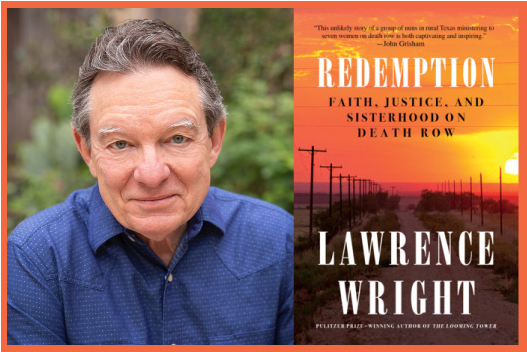
Throughout his writing career, author Lawrence Wright has often explored subjects who belong to somewhat-isolated communities, be it Scientologists in “Going Clear” or terrorists and the intelligence community in his Pulitzer Prize-winning “The Looming Tower.”
And so, while on a walk with a friend whose mother is a leader in Catholic prison ministry, he heard about a connection between two other communities who were set apart from the world: seven death row inmates in a nearby Texas prison and the order of cloistered Sisters who befriended them. That story became his latest book, “Redemption: Faith, Justice, and Sisterhood on Death Row,” and we discussed it recently on “Christopher Closeup” (podcast below).
In a way, this story began in 1994 when an unknown person left a pamphlet and note on Ronnie Lastovica’s windshield describing the role of a deacon in the Catholic Church and suggesting he might have a calling for that ministry. As a husband, father, and successful businessman, Ronnie already had a full plate, but something kept tugging at him about the idea. He decided to pursue it and was ordained a deacon in 2000.
Deacon Ronnie soon began working in prison ministry. In 2014, he was asked to include the Gatesville prison complex for women in his efforts. There, a death row inmate named Linda Carty asked to receive Holy Communion. He visited with her every week, then other inmates began asking to meet with him too.
Deacon Ronnie soon surmised that the women on death row did not get along, comparing them to “feral cats.” That’s when he thought of another group of women who lived similar lives who might be able to help them: the Sisters of Mary Morning Star, a relatively new order that had a convent in Waco. With an average age of 37, they were contemplatives who rarely spoke so they did not regularly engage with the outside world. But Deacon Ronnie gave it a shot.
At the convent, he spoke with the prioress, Sister Lydia Mary, and said, “”Sister, there’s some women that could benefit from your education. They live together, but they can’t get along. They don’t have the training in communal living that you’ve had…I think that you could bring something to them.”
Intrigued, Sister Lydia Mary asked where these women were.
Deacon Ronnie responded, “On death row.”
That answer came as a shock! Sister Lydia Mary said they couldn’t do it – and even if they were willing, they would need permission from their superior. Before leaving, Deacon Ronnie asked them to pray about it. And so they did, wondering if this unusual request might be an opportunity for ministry that God had put in their path. That openness – and permission from their superior – led them to ultimately say they would make the visit just one time.
Recounting the events, Wright said, “They went the first time, and they were terrified. Just imagine, these are women that are very secluded. They rarely go out in the world. And here they are driving up to a prison with… tall fences with razor wire on the top and guard stations at each corner and occasionally you hear gunshots where they’re practicing their target practice.”
Funnily enough, when some of the guards saw the habited nuns entering the prison, they felt nervous themselves being in these women’s presence.
Despite the Sisters’ uneasiness about meeting the death row inmates, that first meeting could not have gone better. Wright said, “They almost immediately fell into each other’s arms and began to talk. And it turned out that the nuns had a gift. They had a way of living that was very helpful to the women on the row. And that first meeting was followed by, since then, four years of them going at least every month. And sometimes nuns will go individually and talk to prisoners that they’ve struck up relationships with. It’s been very meaningful, but the surprise for both sides, I think, was how similar their lives are. They both live in what they call cells. They get up about the same time around 4:30 in the morning and they do prayers and make their breakfast and do their reading – and [the inmates] have crafts that they do and so on….They have outfits that they invariably wear. So basically, there was a sense of recognition and kinship between these groups of women.”
Several of the inmates even became lay oblates of the Sisters of Mary Morning Star.
At Deacon Ronnie’s suggestion, the Sisters aimed to build a more friendly, less hostile state of community among the death row inmates by telling them about a practice from monastic tradition they call Chapters of Fault. Realizing that tensions and misunderstandings can grow out of human sins and frailties, the Sisters meet once a week to take responsibility for when they slighted or hurt others. Then they give thanks for small gestures that their fellow Sisters made during the past seven days. This helped to create a more harmonious atmosphere in the convent.
Wright stated, “The women on death row had been nursing…grudges for years. There were a lot of fissures in their community. And what the nuns brought to them is a way of apologizing and asking forgiveness…This is not something that was practiced on death row up until that point, but [the Sisters] made an example. And sometimes what [the inmates] were apologizing for were actions that seemed negligible to some. But on the other hand, it made a difference just saying, ‘I’ve been under stress recently, and I have been hard to talk to. I’ve ignored some of the things that other people have found important.’…It generated a spirit of mutual forgiveness, and it made a profound difference in the lives of the women who are condemned on death row.”
As uplifting as “Redemption” can be, there is also the other side which Wright does not shy away from: the crimes that the women on death row committed. Some of their acts of brutality were horrific (though Wright also presents convincing evidence that one of the inmates, Melissa Lucio, is innocent).
Wright explores the inmates’ backgrounds, and in almost all cases, they suffered severe abuse and trauma in their past. That doesn’t excuse their crimes at all, but it allows readers to see how the seeds of their future were sown.
“Most of them had run out of legal appeals,” Wright explained. “They were open to the possibility that any day they would get an execution date, and I might provoke that. I, by writing and reminding people of these ancient crimes, would generate a sense of, ‘Well, why are they still alive?’…But on the other hand, as a reporter, I have an obligation to the reader to tell both sides of the story. And if I didn’t acknowledge the victims and the families, then I wouldn’t have been honest about who they are and what they’ve done. And it also sets the backdrop for their transformation. That’s the part of the story that I found most compelling, and that’s why the book is called ‘Redemption.’ In telling their stories, you could see how they’ve been transmogrified into different creatures. Forgiveness and acceptance and religion played a huge part in that, allowing them to forgive themselves and to love each other.”
(To listen to the full interview with Lawrence Wright, click on the podcast link):

