
 Posted by
As co-pilot of the B-24 dubbed Chattanooga Choo Choo, Ernie Poulson had helped his crew of 10 fulfill their part of the mission over Nazi-aligned Romania: dropping bombs on the oil refineries Hitler was using to power much of his war machine. The Americans’ success came at a cost, however, not only to themselves, but to several of the other planes that were also a part of the Allied effort, Operation Tidal Wave.
The Chattanooga Choo Choo took on ground fire, leading to a crash landing in enemy territory and the apparent death of at least two crew members. Ernie and his fellow survivors feared for their lives, but they never anticipated what happened next and the ways in which their seeming-enemies would turn into courageous friends.
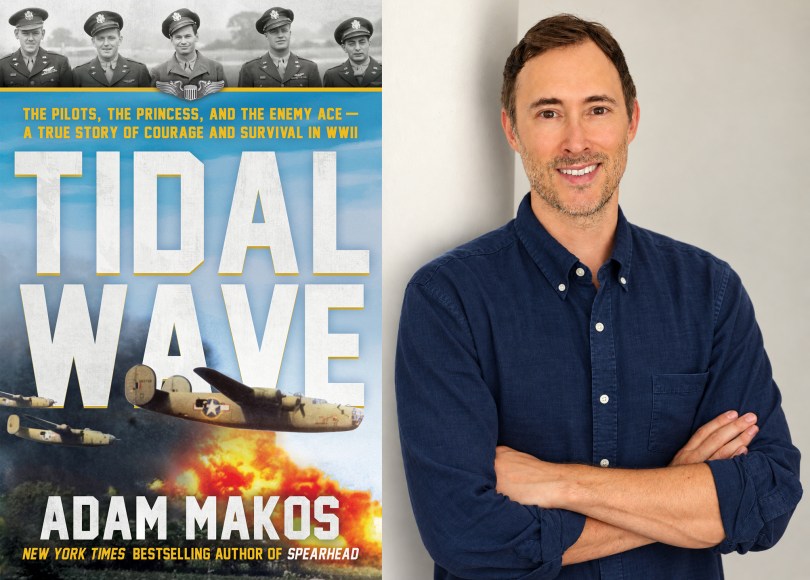
Author and military historian Adam Makos – who has a knack for finding little-known war stories that highlight the best of humanity in the worst of times – tells this tale in in his new book “Tidal Wave: The Pilots, the Princess, and the Enemy Ace,” and we discussed it recently on “Christopher Closeup” (podcast below).
Adam first became aware of Operation Tidal Wave during a meeting with Fred Smith, the founder of FedEx, who had always been fascinated by this unusual episode from World War II. Because so many who fought in that conflict are no longer with us, Adam wasn’t sure he would find the first-person account he needed to flesh out the basic facts. Thankfully, one of its key figures – Ernie Poulson – was still alive at age 96 and had a mind as “sharp as a tack.”
Ernie was 22 when he became part of a rookie crew on the B-24, which was “the latest and greatest American bomber” at the time. The mission, said Adam, “was cooked up by…President Roosevelt and Prime Minister Churchill. They decided that Hitler’s oil fields in Romania, his refineries that were supplying 30% of the Nazi war machine with their gasoline and oil, had to be destroyed, and it had to be done in one big crucial raid.”
Though Romania had been allied with the U.S. during World War I, a recent predicament had sent them into an agreement with Hitler. Adam explained, “At the outset of [World War II], Russia and Stalin had taken some of [Romania’s] land, and they couldn’t find an ally to help them reclaim it or even defend themselves. During World War I, Romania was an ally of us. They fought on the side of the good guys. So they looked to England, they looked to France, they looked to America. And at the time, England was under siege by Hitler. France was subject to the blitzkrieg. America had not entered the war. So eventually, they made this deal with the devil. The dictatorship that took over Romania [from its former king], he said, ‘If we can’t get anybody else to defend us, Hitler will.’ And that’s how they got plunged into the war. So the average Romanian did not want to be part of this thing. It was just a series of bad circumstances that pitted them against the rest of the world.”
As Adam indicated, the hearts of ordinary Romanians were not with the Nazis, which is why what happened next transpired the way it did.
Ernie and his crew were captured by those ordinary Romanians after escaping their plane crash. At first, the Romanians believed their prisoners were Russians because of the white star on their plane. With deep animosity towards the Soviets, the Romanians threw the Americans into a dark cistern where rats scurried around. After some time, the trap door above them opened and they heard a friendly woman’s voice, speaking perfect English, saying, “Hello, boys.”
“It was Princess Catherine Caradja,” Adam said. “She had the men brought up from the pit, and she told the Romanian guards, ‘These are Americans. These are friends.’ It turned out they had crash-landed on her estate. She owned 1,000 acres around the Ploiesti oil fields, and she was an unusual princess. She spent her wealth and her time looking after orphans…[Her mother] had started an orphanage. And at the time, the orphanage had 25 orphans. By the time Catherine was 50 years old, it had 3,000…They were mostly war orphans from Poland who had lost their parents in Hitler’s blitzkrieg earlier in the war. So, she already had a lot of orphans on her hand, and now this crew of nine Americans drops in and she takes on responsibility for them.”
Originally, Ernie believed that two of their crew members – Frank Kees and Richard Britt – had been killed in the crash. It turned out Britt was still alive but trapped in the wreckage. When Princess Catherine came to investigate the crash, she heard Britt’s cries for help, so she had a young man and a boy cut him out and save his life.
At this point, it would have been routine for the Princess to turn their prisoners of war over to the Nazis, but she knew that would endanger them, so she defied Romania’s occupiers and took control of the POWs herself: not just Ernie’s crew but 110 total Americans who had survived being shot down.
“And so, the Americans were put in the strangest POW camp of World War II,” Adam said. “They were sent to the Transylvanian Alps, essentially to a hotel….They had heaters in their rooms, and they had servants who would look after them who were Russian POWs. They were served a steak dinner their first night there, and they had the radio to listen to. And it all set up this great conflict for the Americans, [who thought], ‘How can we enjoy this good treatment while our friends are still fighting and dying in the air war over Europe?’ That leads to this big clash between captor and captive.”
Another key figure in protecting the Americans was 21-year-old King Michael, the country’s former ruler who became a figurehead when the dictator Ion Antonescu took over Romania.
“[Michael] was a deeply religious figure. He learned it from his mother, Queen Helen, who was herself the daughter of the King of Greece…His favorite book was the Bible, and he felt that prayer is our most important duty in our relationship with God…So Michael is a figurehead, but he knows he has the love of the Romanian people, partially because he was a very self-effacing monarch…Michael would take this experience and he would…vow to overthrow the Romanian dictatorship so that these Americans could one day make it home.”
The story that Adam tells in “Tidal Wave” takes more twists and turns, highlighting the heroism of the Americans and Romanians who ultimately defeated Hitler. The book also extends beyond the war to the Soviet takeover of Romania and how the “boys” that Princess Catherine saved ultimately wound up saving her.
When asked what he hopes readers take away from “Tidal Wave,” Adam concluded, “I hope that they come to know these names and these people, because a lot of young Americans died on this mission….They gave their lives in Romania in 1943, August 1st, and they made the sacrifice…We hear it so much – ‘We have the lives today because of what they did’ – but it’s true. It’s easy to forget because it happened a long time ago, it happened far away. We need to remember their names. We need to speak their names. People like Princess Catherine, King Michael, Ernie Poulson, these are great human beings. And so we need to remember them, to honor their existence, to tell their story, to inspire people. But I think that’s the most important thing. It’s the sense we cannot let stories like this go silently into the past.”

