
 Posted by
 “If you can help me get a job, I won’t sell drugs.”
Early in her career as a corrections officer for youth, Teresa Goines heard this statement from numerous young people who wanted to follow the right path once they got out of jail. But they were not given any opportunities to make money legally so they often turned back to the crimes for which they got arrested.
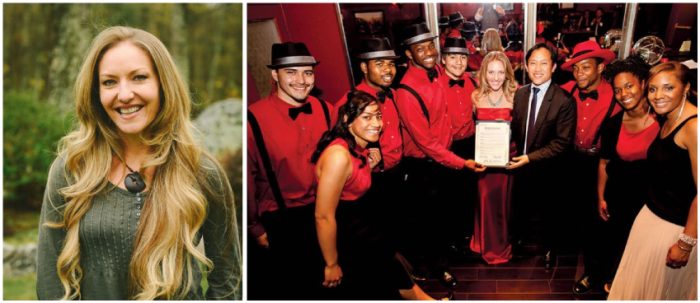
Through a lot of prayer and hard work, Teresa created those opportunities herself through a unique nonprofit business – a San Francisco supper club named Old Skool Cafe – that continues to serve as a beacon of hope for formerly incarcerated young people and at-risk youth. We discussed her work recently on “Christopher Closeup” (podcast below).
Having grown up as a caregiver for a disabled parent and grandparent, Teresa felt drawn to pursue a helping profession. As a psychology major in college, she worked with boys in a mental health ward and was trained as a call operator for a suicide hotline. But she was also curious about a career in law enforcement, perhaps, she admitted, because she “watched a lot of cop shows.”
“I thought maybe I would want to go along with first responders to be there as a liaison with the community when trauma was happening,” Teresa reflected, “or maybe a psychologist for police officers who are witnessing so much and often don’t know how to process [it].”
At age 20, Teresa began an internship with a probation officer named Sergio Martinez, who worked with “the heavy offenders unit…We did stakeouts and drug busts, and he would put a bulletproof vest on me and a probation jacket and let me go into everything with them…That was exciting. It was interesting. It wasn’t a desk job.”
Upon graduation, Teresa was offered a job as a corrections officer at juvenile hall. She recalled, “That opened my heart and mind to how many young people are actually institutionalized…When you see kids that are 13 and 14, that don’t actually believe they’re going to live to see their 18th birthday – and don’t have hopes and dreams of having a family and traveling and pursuing a career because they just feel like they’re going to either be dead or in prison – that rocked my world and completely changed the trajectory of my life.”
It’s easy to look at incarcerated youth from a distance and judge them and their choices. But getting to know them on a human level painted a more complex picture of why they did what they did.
“A lot of them were coming from poverty,” Teresa explained. “They were living in neighborhoods that were full of violence and illegal ways of making money. That’s what they saw around them…Naturally, all of us tend to follow what we see…So how do I make money? How do I fit in? What’s the community? Where do I get acceptance and respect and love? And I always say the gangs were also offering those things….To have a group of guys come around and be like, ‘You belong. You are a part of us. We have your back, we’re your family, we’re your community, we’ll protect you, we’ll provide for you’ – if that’s what you have and that’s what you see, that can feel very attractive and compelling. And…if you’re not seeing a different option, you’re going to go with your best option.”
The youth realized their way of life was a dead end, so they would tell Teresa, “If you can help us get a job, I won’t sell drugs.” That lack of jobs inspired her mission once she left her work as a corrections officer. She said, “There has to be a better option to choose better. But if you don’t see any other options and we just say, “Do good…Don’t go back to making money illegally,’ we’re totally setting them up to fail. Especially back when I started, nobody was hiring somebody that had a record, that had a felony…And so we’re saying, ‘do the right thing,’ but yet we’ll close all the doors. Nobody will hire you to make money legally. Well, what do we want?”
Teresa hoped to find existing businesses that would give these young people a job, so she prayed, “God, give me a vision, give me a solution.” When no potential employers stepped up, she finally decided to pursue the creation of a restaurant herself because of all the entry-level jobs it could offer, as well as the room for advancement.
Teresa credits her creation of Old Skool Cafe to not knowing all the work that would be involved. “If I had come from a restaurant world, I probably never would’ve done it because I would’ve understood how hard it would be and how crazy.” She showed her business plan to one restaurateur, who told her, “It’s the worst idea I’ve ever heard.”
There were too many positives for Teresa to give up on her dream, though, so she started her business in her apartment in 2004. She recalled, “I did the mentoring, I did pop-ups, I worked with the chefs to do catering and events.”
Through it all, she continued to pray. “God was so gracious,” she said. “I prayed and asked him every step along the way. And He would bring people that would advise me, people that would volunteer, people that would help, that would step in…And then we got…the building that we’re in now in 2011. We had volunteers, and the youth helped us renovate it, and then we opened to the public in 2012 as…a full restaurant jazz club.”.
.
As described on its website, Old Skool Cafe is a “1920s-style speakeasy jazz restaurant…As a faith-based, violence prevention program, Old Skool Cafe empowers at-risk, formerly incarcerated, and foster care youth (ages 16–22) through job training, employment, and a supportive community. Our youth-run supper club serves soulful, global comfort food inspired by the rich cultural heritage of our young chefs—from West Africa to the American South. Here, every dish tells a story of resilience, transformation, and hope.”
Teresa has witnessed plenty of stories of resilience, transformation, and hope over the last two decades, and they always feed her soul. “It’s way better than winning the lottery,” she concluded. “When a young person that doesn’t love themselves and doesn’t feel like their life matters…and feels unloved and feels thrown away, that’s had a lot of rejection and a lot of trauma – when they start to know their value, that God loves them, that they are created for a purpose, that they’re loved, that they’re wanted, that they’re not a mistake – they start to [blossom].”
“I think the other thing is when you see them smile, authentically smile and laugh, because we can’t really laugh until we feel safe…When you feel trust, when you feel safe, when you feel loved, that’s when the sky is the limit…[We have] youth that have been able to get their own housing and develop good relationships. Some of our young people that had a horrible, horrible childhood, I’m watching them be amazing parents now. And [I think], ‘That’s incredible! You never received any of the stuff I’m watching you give your child.’ They’re my hero.”
(To listen to the full interview with Teresa Goines, click on the podcast link):

