
 Posted by
 Joe LaHood grew up in somewhat unusual circumstances. His parents, Dan and Cubby, turned their Maryland home into a daycare center that welcomed children with intellectual and developmental disabilities, and they named it St. Joseph’s House. As a result, Joe and his siblings developed a closeness to a group of people that society often prefers to hide away.
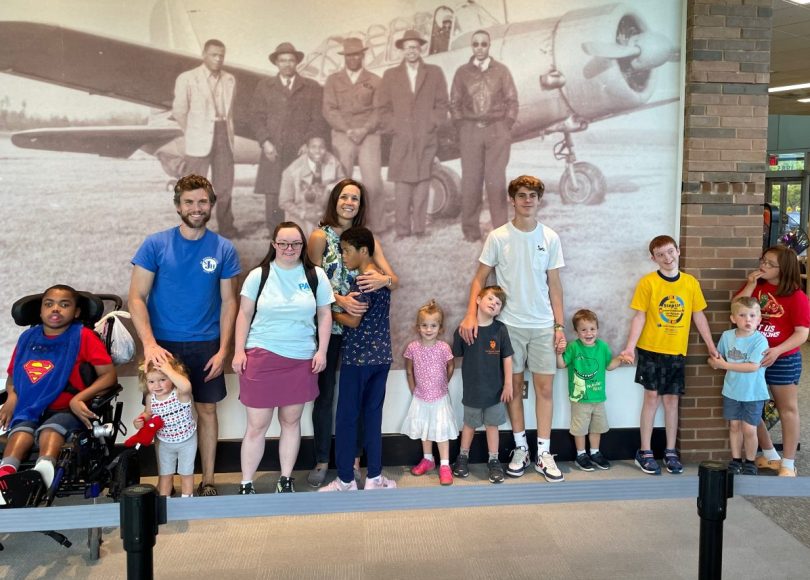
In recent years, Joe and his wife Natalie took over the the running of St. Joseph’s House, moving it into their own home, where they are raising their five children. Joe and Natalie joined me on “Christopher Closeup” (podcast below) to discuss their work, how it serves as an extension of their faith, and how it reflects a slice of heaven on earth.
In 1983, Cubby LaHood was pregnant with her first child and wanted to work from home. She decided to offer daycare for children with disabilities because that’s what she had experience doing,
When Joe was four, Cubby gave birth to another son, who lived only for a few minutes. Dan and Cubby had only been nominal Christians up to that point, but their son’s death – and the realization that he would have been extremely disabled had he lived – led them to a reversion to their Catholic faith and a renewed commitment to their home-based daycare work, which they renamed St. Joseph’s House.
Joe reflected, “I think the life of my whole family, – the faith that was born through the witness of my younger brother’s death – has been with us through the last decades in recognizing that this [work] is…something that is born to try to bring our faith, some slice of heaven…to the families that we serve.”
“When you’re a child growing up in this environment,” Joe continued, “you adapt to what is around you and learn so much from that. I was given so many gifts from the kids, just in terms of being able to understand how we are all created in the image and likeness of God, no matter what we look like, what we sound like, if we can walk, if we can’t walk, how we eat, if we’re fed through a tube, or if we’re able to use our hands. Just being able to experience the beautiful diversity of the human person was such a gift to me as a child. And now that Natalie and I’s children get to experience that as well, it’s just incredible.”
Natalie didn’t get to know Joe until 10 years ago, but she had already developed her own passion for helping vulnerable human beings. During high school and college, she had volunteered with children with disabilities. Then, she took part in a program called Heart’s Home, which involved traveling to Thailand “to be a presence of friendship and compassion with those who were the most isolated and suffering…For us, that was a lot of children and adults with disabilities, a lot of homebound elderly, a lot of refugees…That instilled in me the importance of being able to be a compassionate presence for anyone in the world. The deepest desire of the human heart is to know that we’re not alone, that we’re loved by God and those around us, and to know that we have someone to accompany us.”
When Natalie met Joe, he was the first person whose values and experiences reflected her own, so they immediately connected. “We decided that it was on our hearts to continue this work before we were even married,” Joe explained. “So we were engaged, and my mom had just died at the age of 58 after a years-long battle with ovarian and breast cancer. We knew how important this work was to all of the families that we serve, but we also knew that there were going to be so many more families, too, in the years to come and…they can live very isolated lives. We decided that we wanted to do this for our family, for their families, and to make it part of our greater community as well, which we really have tried to do here in Hyattsville, Maryland, where we live.”
The “kids” at St. Joseph’s House range in age from five to 21. The community they have found there is making a profound difference in their lives. Natalie explained, “Many are with us, and with each other, for years of their childhood and adolescence. And to see a nonverbal autistic child walk into our home and light up with a smile and know…where their friends are…where they know they’re known and loved, and they don’t have to have any guards up or barriers, they don’t have to perform, they just can come and be themselves, is really beautiful to be a part of.”
Joe added, “A lot of these kids just want to be kids, too, and hang out with other kids, not necessarily kids who only have disabilities. So to be able to have our five small children – our oldest is nine – be a part of that, and other community members come to our house and be a part of that, I think it’s a real gift for the kids on both sides of that equation to grow into more empathetic and loving and caring human beings.”
Natalie noted that there is “a rhythm” to each day and that the kids thrive on “structure.” They arrive between 9:00 and 9:30 every morning, then head out on a field trip, to places such as libraries, museums, parks, aquariums, the movies, arcades, bowling, etc. In addition to being fun, this allows the kids to interact with members of the community so they can all get to know each other better. Joe reflected, “I think there is still a fear of disabilities in the world out there, and until you are able to…just be around people with developmental differences, that helps to slowly cast away that fear. And then [through] that encounter with the other person on a very human level, the fear dissipates and you start to see the other person for who they really are.”
The amounts of activities the group engages in on each field trip is small because of the kids’ needs. But Natalie recognizes, “That’s not bad. It’s okay to move at a slower pace, to really just enjoy being together…In this day and age where efficiency and a quick pace is ever more prevalent and a temptation. I think that’s something nice about the pace of our days. And so after a field trip, we’ll come back to our house…where we’ve got a playhouse that volunteers built for us. It’s wheelchair accessible. We’ve got a big mud kitchen and a swing set and every kind of yard toy you could think of, and then a big recreation room where everyone can hang out and play games and sing and read and play.”
In witnessing all the good that St. Joseph’s House accomplishes, the LaHoods see it as a candle in the darkness reflecting God’s divine light. Natalie observed, “[Seeing] the way that these families love their kids is to see the face of God and to know the way that God loves us. No matter how broken we are, no matter what challenges we encounter, no matter what we can or can’t do or give back in any moment of our lives, that just for being made by God, we are so, so, so infinitely loved. And our God goes to the ends of the earth to love and serve us, and we see and have that kind of flame rekindled by the families so often.”
Joe hopes that through their efforts at St. Joseph’s House – and through interviews like this – society will be more embracing of families dealing with disabilities. He concluded, “[Don’t] be afraid, if you see someone with a disability at the playground or at school, to treat them like a normal child and befriend them or talk to their parents. Because, like we said, it can be very isolating. So I feel like that’s our mission at St. Joseph’s House: to help get kids and families out in the world so there can be encounters and real relationships made. We hope that’s what we do in our community, and we hope that that can happen in other communities as well.”
(To listen to the full interview with Joe and Natalie LaHood, click on the podcast link):

