 Posted by
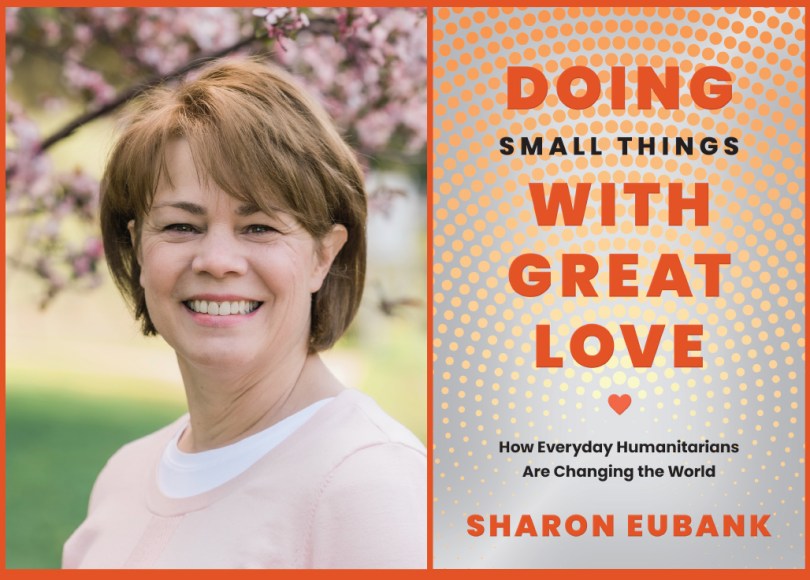
 Sharon Eubank spent nearly 30 years doing humanitarian work around the world, but it all started with socks. Yes, socks. A seemingly inconsequential item changed her perspective about the ways that we can serve others, and she has now shared what she learned in the informative and motivational Christopher Award-winning book “Doing Small Things with Great Love: How Everyday Humanitarians are Changing the World.“
During a “Christopher Closeup” interview (podcast below), Sharon recalled a moment in the 1990s when she found her mother knitting bright red socks. When she asked her why she was doing that, her mother responded that there was an airlift taking donations to Sarajevo to help the people suffering there during the Yugoslavian War.
Sharon thought to herself, “Is that the best we can do? Have women in middle America knitting socks for all the things that those people needed?”
“Then a couple of years later,” Sharon continued, “I read a story in The New York Times about a woman who was in Sarajevo. Her building had been bombed. She was living in the basement, and the pipes had broken so everything was freezing, frozen ice. She said a Red Cross truck pulled up into the yard, and they distributed brand new wool socks. She said she put her filthy feet into those socks and pulled them up, and she felt so grateful for whoever had provided them. Of course, the bigger issues still remained: the war was still going, the bombs were still falling. But for that moment, that woman, that was what she needed. It made a difference…I recognized that rather than just focusing on ‘I can only do the big things; the small things don’t matter,” it’s the right thing that comes at the right time for the right reason that makes humanitarian aid valuable. And so the thing that my mother was doing, if it was delivered in the right way at the right time for the right people, it would make a difference.”
The simplicity of that idea guided Sharon’s humanitarian work and, decades later, led her to write “Doing Small Things with Great Love,” the title of which is derived from Saint Mother Teresa’s famous quote, “We can’t all do great things, but we can all do small things with great love.”
Sharon explained, “The emphasis isn’t on the thing that you’re doing, which we often think that it is. It’s on the way that you do it…[Mother Teresa] worked with some of the hardest, lowest-caste people in India. As they were dying, she brought them into her place. She washed their feet. She removed the filth of the street. She tucked them into clean sheets. She held their hands while they were dying. And she looked in their eyes and said, ‘You are worthy of this. God loves you. I’m an instrument of His love.’…Even though they were small things, ordinary things, that made all the difference…So I wanted to highlight, you don’t have to worry that what you’re doing is small because if you do it with great compassion, it becomes something divine.”
The dignity of the human person is a recurring theme throughout the book, and Sharon commends faith leaders like Pope Leo, “who talks a lot about the dignity of each person, the respectful treatment, the humane solutions that must be part of how we tackle difficult things…In my experience over 30 years, people don’t change unless they completely feel like you respect them and you love them. Once they feel that, your partnership explodes. And it isn’t the thing that we’re giving them – It’s not the food; it’s not the medical care. It’s that respect that they crave in their difficult situations that we can give the most.”
This also ties in with the interfaith aspect of the book. Though Sharon worked for the humanitarian arm of the Church of Jesus Christ of Latter-Day Saints, she worked with and befriended people of many different religions, both in terms of her fellow aid workers and the people they were serving. These are relationships she treasures.
“We often focus on the differences between our faiths,” Sharon observed, “and it creates a lot of contention, but I think there are some basic things that we all believe in…Faith acknowledges our human dignity, and I quote in the book, ‘We’re all equal before God. We’re all his children, and he weeps when we forget this and we act as if we hate our own blood.’ And so, if we can find the common humanity, just that we’re all part of the same family and treat other people the way we would like to be treated, the differences in faith kind of fall away, and we all act as if we were children under one God. To me, that’s the foundation of how we can have more dignity.”
This attitude requires humility, which is also the key to successfully providing aid to others. Rather than coming into a situation and thinking you know best, humanitarians need to listen to the people they are serving and learn what they want.
One example of why this approach is important comes from Italian author Ernesto Sirolli, whose story Sharon shares in her book. While working with an Italian aid organization in Zambia, Sirolli noticed they had a lot of fertile land for agriculture, so he and his co-workers planted Italian seeds and grew a bountiful tomato garden. “Look, it’s easy!” he declared to the Zambians.
But one night, the hippos came out of the Zambezi River and ate all the tomatoes. The aid workers were aghast that all their hard work had been for naught. They expressed their disbelief to the Zambians, who responded, “We know; this is what they do. It’s why we don’t grow agriculture in this area.”
The Italians questioned, “Why didn’t you tell us this?”
The Zambians replied, “Because you never asked us.”
Sharon noted, “That scenario has played out over and over again because we think we know, and we don’t ask the people and become partners with them. So we make those mistakes over and over again.”
On a more positive note, Sharon shared another story that combined a specific group’s needs with the idea of taking the initiative to solve a problem. The key player was a man named Mr. Gabriel who, by age 52, had already been a refugee three times. Most recently, a conflict led him to join a mass exodus to Uganda, where hundreds of thousands of people found shelter in refugee camps.
There, Mr. Gabriel saw thousands of children who were no longer learning in school, which meant their futures would be severely limited. After recognizing other teachers in the camp, Mr. Gabriel convinced them to gather the kids under the shade of different trees and teach them their lessons there. The project became a great success.
Sharon recalled, “I was so amazed at [Mr. Gabriel], who had every reason to sit there and say, ‘I need someone to help me.’ Instead, he looked around and said, ‘There’s something that I can do. Even though I’m one of the refugees and we don’t have enough food and we’re in an inhospitable location, I see other friends that are teachers, and here’s something that we can do.’ And they went ahead and did it. They didn’t wait for other people to give them permission or supplies. They just acted…It elevated the whole camp because people realized, ‘We’re capable. Even though this terrible thing has happened to us to drive us over a border, we’re still able to do things.’ Parents felt good that their kids were in school, teachers felt supported in their community, and kids were still learning. They were powerful as a community because they were able to do those things.”
Though “Doing Small Things with Great Love” features numerous international examples, Sharon also points out that individuals are most powerful where they live and that volunteerism is open to all of us. And once again, it helps us get to know each other as human beings rather than judging each other based on preconceived notions. .
“One of the great tools that I really appreciate is the app, JustServe,” Sharon said. “You type in your zip code, and up come all the volunteer opportunities that are coming up. Some of them are things you can do at home; some of them are things online. But when I did this in my own community, I realized there is a food bank just down a hill in a strip mall run by Catholic nuns that I didn’t know about. And it’s in my own neighborhood! When I went down there and spoke to the nuns, they said, ‘We really need Spanish speakers to help with the food distribution.’ Awesome! Now I know what to do. Now I can take my neighbors and the Spanish speakers there, and we can go support that food pantry that’s in our own community that I didn’t know about.”
During her 30 years of humanitarian work, Sharon has seen many times of darkness. But as it says on her Christopher Award, she continues to light candles in that darkness in whatever way she can.
Sharon concluded, “Doing humanitarian response to some of the biggest issues in the world, it takes a toll. It’s a hard emotional thing because there are things that we can do and lots of things don’t work out and some things we cannot fix…The thing that I wanted to do…is [share] this idea that everybody can do something. You don’t have to belong to a big organization. You don’t need a big pot of money as a wealthy person. There are things in society that each person can do that drive that darkness back, and they don’t require systems or cash. And I just want to say from 30 years of experience, the most important things happen from these interpersonal relationships that build up society…We can’t remain this polarized. The only thing I can think of to do is to encourage people, get to know each other and serve each other and respect each other and see if we can take the temperature down. That’s my greatest hope.”
(To listen to the full interview with Sharon Eubank, click the podcast link):

