 Posted by
 (Today, we’re resharing a classic interview from 2016 with a country music legend).
“Nothing ever grows where the sun always shines.”
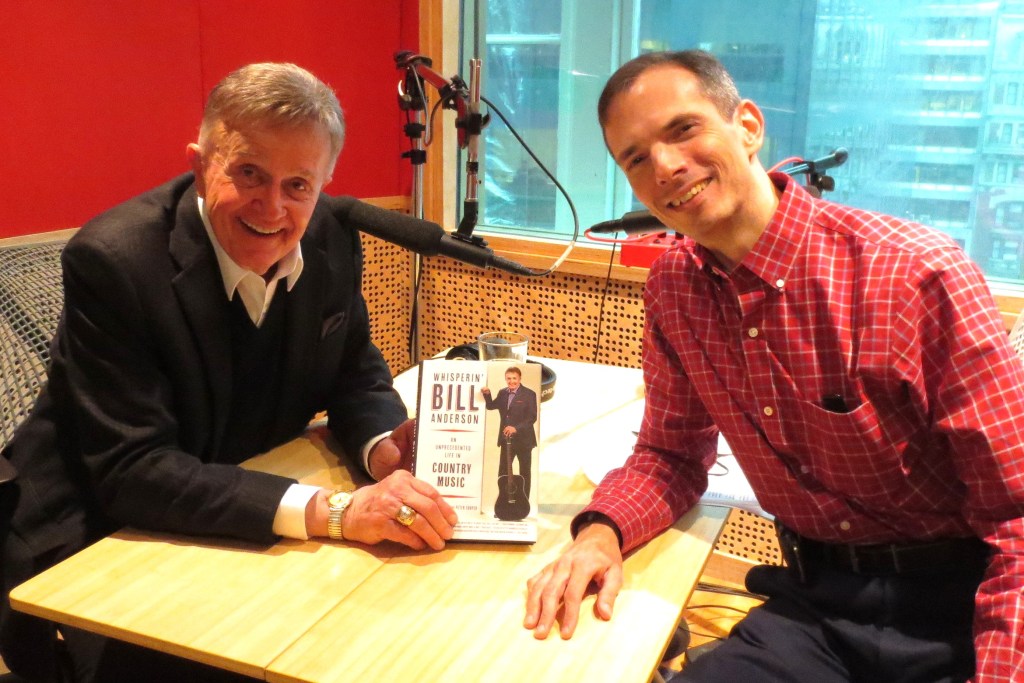
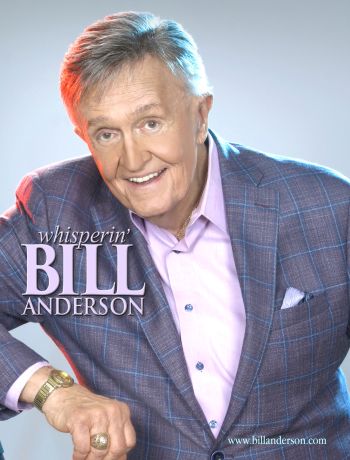
Legendary country music singer/songwriter Bill Anderson wrote that lyric because it reflects the truth of his life: that it takes both the sunny days and the rainy ones, the successes and the failures, to truly grow and mature and become the person God created you to be. He shares many of those moments in his autobiography “Whisperin’ Bill Anderson,” and we discussed it on “Christopher Closeup” (podcast below).
In the 1950’s, at the age of 19, Bill wrote his first hit song, “City Lights,” for Ray Price. Bill’s own performing career launched soon after, and he scored hits with songs such as “Still.” In later years, he became an in-demand songwriter for plenty of modern country artists. He co-wrote “Whiskey Lullaby” with Brad Paisley, “Which Bridge to Cross, Which Bridge to Burn” with Vince Gill, and “A Lot of Things Different” with Kenny Chesney. Bill was also inducted into the Country Music Hall of Fame and the Nashville Songwriter’s Hall of Fame – and he is the longest-active member of the Grand Ole Opry.
But where did it all begin for Bill? He grew up in Georgia with a passion for three things. “I loved sports, I loved country music…and I loved to write,” he recalled. “I was the nerd in class who, when the teacher said, ‘We’ve got a paper to write,’ I’d go, ‘Oh boy, when do we start!’ Because I just always enjoyed putting words together.”.
The seeds of faith were planted in Bill’s life partially by his grandfather, who was a Methodist preacher. But his mother was his primary influence. Bill said, “I wrote a song early in my career called ‘Mama Sang a Song’ where I talk about the fact that in my growing up years, my mother exhibited her faith to me through music. I could see her standing at the sink washing dishes after a hard day, singing ‘Amazing Grace’ – or sweeping the floors or vacuuming the carpet singing ‘Bringing in the Sheaves’ or all these old great songs. Those songs of the church were really, without me realizing it, forming a foundation for me musically.”
“In fact, I’ll share a little story with you,” Bill continued. “When I first got to Nashville and was with my very first music publisher, I had turned in some new songs. [The boss] called me to his office one day and said, ‘Anderson, I just want to tell you one thing…All of your melodies sound like they came right out of the Methodist hymnal.’ I said, ‘That’s because they did. That’s the music I grew up, with and if I’m copying, then it, so be it.'”
Bill did not come from a show business family. His mother was a homemaker and his father was an insurance salesman who ran his own business in Decatur. This might have prompted his parents to discourage Bill’s ambitions for a music career as he got older. But the opposite happened.
Bill noted, “You fathers that are listening right now, let me give you some great advice. Let your kids do what my father let me do…I could’ve, as his only son, taken over [his] business and had a nice living from day one. But I was totally a square peg in a round hole in his office. I worked for him one summer and I never could figure out what he did, let alone how to do it. He knew I had this dream of being in the music business or being in radio or television…and he didn’t try to push me to try to follow his footsteps. He said, ‘I chased my dream. You go chase yours.'”
As Bill achieved success and hosted his own syndicated television show, a comedian named Don Bowman would tease him about his breathy voice and the way he would do narration in the middle of a song. Bowman nicknamed him, “Old Whisper,” which eventually evolved to “Whisperin’ Bill,’ the nickname that has stuck throughout his career.
Another major moment in Bill’s life came when his 88-year-old pastor-grandfather was dying and wanted to visit with him one last time. This man who had spread the word of the gospel throughout his life called him over to his bed and said, “Billy, I don’t know much about the business you’re in, but I know that you’re in a position to reach more people with one song than I’ve reached with every sermon I’ve ever preached.”
From then on, Bill felt that weight of responsibility to create music that would reflect his values and make a difference for others. Of course, in the genre of country music, you have to also cover songs about drinking and infidelity. But, as Bill joked, “The good part is that if you play the songs backwards, they sober up and they come home.”
Many fans credited Bill’s hit “Still” with saving their marriages. He also shared a story about another song: “I got a letter one time when I had a song out that I wrote called ‘Five Little Fingers,’ which was the story of a man who had lost his wife and had a small child. He wondered how he was gonna continue to go on with his life. The little girl walks in and puts her five little fingers on top of his hand and inspires him. I had a fan write me from down in Louisiana one time when that song was out and he said, ‘I was in my car. I was driving out into the swamps. I was going to commit suicide. I thought everything I had in the world was lost. Your song came on about the Five Little Fingers…and I realized I had five little fingers in my house that depended on me. I pulled over to the side of the road, and I listened to your song. I cried. I prayed. I turned around and I went back to town.'”
“That’s not the only letter I’ve had like that,” Bill continued. “It makes me realize that what my grandfather said – that I can reach more people with one song than he reached with every sermon he ever preached – I guess in a way the song at that point in time, maybe that was my sermon.”
For 25 years, Bill had great success. But in the early 1980s, he felt “the tide changing a little bit,” in that songs were becoming more pop-oriented than the traditional type of country he was used to. Other opportunities came his way so he started appearing as a guest on a lot of game shows, he hosted a game show himself, and he played a recurring version of himself on the soap opera “One Life to Live” for three years. Then, in the early 1990s, singer Steve Wariner had a hit with an old song of Bill’s, “The Tips of My Fingers.”
Bill realized that maybe the country music industry had not changed as much as he thought. “It re-lit the fire in me that had been burning low, and I started writing again,” Bill recalled. “I began to co-write with other people. I had not done much of that in my early life and I guess that’s why they subtitle my book ‘An Unprecedented Life in Country Music’ because I don’t think anybody had ever quite done what I did. I had a good 25 years [of success], then I took 10 or 12 years [away], and then I came back. And the years since I came back have been even more fruitful than the years before, so I have been incredibly blessed, and if the life I’ve lived has been unprecedented, it’s also been a lot of fun.”
As Bill returned to the Nashville scene, a friend suggested he co-write a song with Vince Gill, who was “the hottest act in country music.” Bill responded, “He doesn’t even know who I am. I’m an old dinosaur to him.”
But Bill’s friend insisted the two would get along very well, so he gave him Vince’s phone number. Bill carried that number around for about a year before working up the nerve to call him. He expected to have to explain to Vince who he was, but when Bill got his voicemail, the message said, “Hi, this is Whisperin’ Gill, and I’m glad you called.”
Bill felt happily surprised, exclaiming, “Not only does he know who I am, he’s stealing my act.” As predicted, Vince and Bill got along wonderfully and co-wrote Vince’s hit “Which Bridge to Cross, Which Bridge to Burn,” which Bill says “legitimized me again as a songwriter.” That opened the door to many other collaborations, including “Whiskey Lullaby” with Brad Paisley, who sang the song with Alison Krauss. It became the number one song of the year in 2005.
When asked to reflect on the Christopher idea of lighting a candle in times of darkness, Bill went back to that earlier point about “Nothing ever grows where the sun always shines.”
He said, “The darkest it ever got around me was in 1984 when my wife was nearly killed in a head-on automobile accident caused by a drunk driver. At the time, our son was six years old. I had to become mother and father to [him] for a long period of time as my wife went through…rehabilitation, and it really changed my life. It changed my perspective on things. It changed my value system. I realized things that were so important to me that maybe I had not realized up to that time. You do that when there’s a little six-year-old looking up at you and depending on you and you’re the only person that can take care of his needs at that particular point.
“My son and our relationship became my candle in the darkness. He was in a Christian school, and he understood at his young age that there was faith and there was hope and that hopefully his mom was gonna get well, which she ultimately did. I wouldn’t want to walk through that dark spot again, but the light of that candle has served me well in the time since then. I hope in some small way that maybe I can carry a candle for other people. They tell me sometimes, ‘We love your music. Your music makes us feel better.’ If that’s my candle, then I’m more than glad to carry it.”
(To listen to my full interview with Bill Anderson, click the podcast link):