 Posted by
 On August 6th, 2014, the terrorist group ISIS attacked the city of Qaraqosh in Iraq, leading more than 40,000 people, many of them Syriac Catholics, to flee their homes and country. They became part of a larger exodus of refugees fleeing wars in Syria and Iraq, desperate to find safety for themselves and their families.
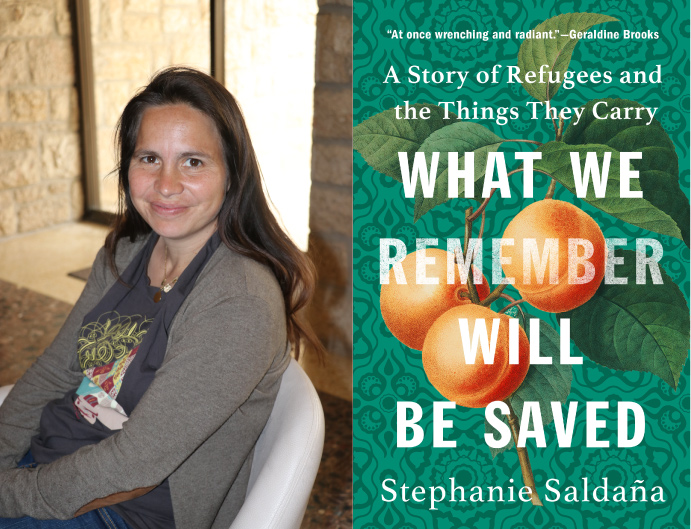
Author Stephanie Saldaña, a Syriac Catholic herself, has now collected the stories of several refugees from both Syria and Iraq who managed to take small pieces of their homelands with them as they embarked on their journeys of survival. Her book is called “What We Remember Will Be Saved: A Story of Refugees And The Things They Carry.” Stephanie and I discussed it recently on “Christopher Closeup” (podcast below).
In 2004, Texas-born Stephanie moved to Syria to study as a Fulbright Scholar. She learned Arabic, met the man who would become her husband, and made many Christian and Muslim friends. When Syria’s civil war broke out in 2011, she was no longer living in the country, but knew many people who were.
“It was not a story about strangers,” Stephanie explained. “It was a story about my friends, former neighbors, and former teachers, so I was personally invested…I’m also a member of the Syriac Catholic Church. And so, when Daesh, what we call ISIS, moved into northern Iraq [in 2014], and hundreds of thousands of people were displaced, many of them were from my church community…[I] wanted to figure out how to share some of those stories with the world.”
In order to share the story of the Catholics from Qaraqosh (also known as Baghdeda), Stephanie traveled to Amman, Jordan, where many of them had resettled. She met Father Elian, the priest from Qaraqosh who now ministered to his flock in this new country. Stephanie also attended the Mass he celebrated and was moved by the beauty of the choir singing in their homeland’s language of Syriac, “a liturgical form of Aramaic.”
Stephanie described it this way: “It was as if the space began to slowly be lit from the inside. One person after another began to sing along in Aramaic, first softly and then with more confidence, until the church was alive with the song of a people who—for a very brief moment—were home again.”
Following the Mass, Stephanie met many of the refugees, including Hana, who had created a dress unlike any that Stephanie had ever seen. With bright colors, Hana had extensively embroidered Baghdeda’s history, traditions, and people into an article of clothing that could have hung in a museum as a work of art. It was her way of keeping her town’s history alive for herself and others.
Stephanie explained, “So many other people I’m writing about, they see themselves as part of a community. They’re realizing that their communities are fragmenting, and so they’re trying to find ways of holding their communities together. For [Hana], this is a dress for her, but also somehow for everyone she knows, for her town, for her family. It’s an act of memory. ISIS was engaged in the project of destroying memory, intentionally targeting religious shrines of Muslims, of Christians, of Yazidis. And so, the people who were affected also set out on this incredible act of…resistance…of saying, ‘You don’t have the power of destroying our memories, of destroying our pasts.'”
Though it would be understandable if the refugees featured in “What We Remember Will Be Saved” might lose their faith in God because of the horrors they endured, the opposite is true. The Syriac Catholics in Jordan find the practice of their faith to be a source of comfort and unity. Others, such as pharmacists Adnan and Gharir, who are Muslim, talk about putting their trust in God. And Qassem, who is Yazidi, “talks about the power of preparing his prayer of offering himself for others.”
Another aspect of Middle Eastern life featured in the book is the prominence of interfaith friendships. Stephanie noted, “When people were displaced, one of the things they spoke to me the most often about was their devastation and losing their interfaith friendships. I have lived in the Middle East for nearly two decades, and that’s certainly a deep part of my life: my relationships with people of other faiths, how we take care of each other during holidays, how we give each other gifts, how we give each other greetings.”
As an example, Stephanie recalled meeting Munir in the refugee camp Moria in Greece: “He lived in a mixed neighborhood in Mosul: Muslim and Christian. He tells the story of how Christians in his neighborhood were targeted beginning in 2003, and how he protected them, how he went systematically and protected his neighbors…So, by putting these stories of different faiths next to each other in one book, I wanted to preserve the feeling of what it was for us to be neighbors, because unfortunately, this sense of migration that’s happening means that many of those friendships are now dispersed.”
Stephanie added, “In this extraordinary story of Adnan and Ghadir, these two pharmacists in Aleppo rebuild their pharmacy in a garage…so that their neighbors don’t have to travel long distances for medicine. And they tell the story of their very cosmopolitan families, of her father who was best friends with a Christian. So, you can see that it’s not just the characters; it’s multi-generational.”
Adjusting to life in a new country is difficult enough, but for some, like Munir, the refugee camp in which he finds himself is less than ideal. Stephanie visited Moria in 2017. She said, “It’s a place where all of the refugees who were arriving on the Greek Islands were funneled in order to be processed. When I was there, there were meant to be 2,200 people there, and there were over 7,000. It got even worse after I left…It’s the place that Pope Francis visited and referred to as a concentration camp. The conditions were horrible, horrible, horrible. And the people who found themselves, there were people who at that time had escaped the worst conditions of the war. So, there are people who had lived under ISIS in Mosul…and then with their children, they risked their lives on the sea expecting finally when they saw the shore to have some kind of relief and safety at last. Instead they found themselves in this horrible camp. For me, it was absolutely devastating. But I met…Munir…who not only told me the devastating story of what had happened to him, but really described how he was kind, and how they were kind to one another, and how they really did the work of staying human in the face of this inhumanity.”
Deaspite the hardships and the horrors of war and genocide in “What We Remember Will Be Saved,” Stephanie believes it is ultimately a hopeful book filled with “extraordinary human beings” who have managed “to remain good and to remain kind and to love. I often think about the Dorothy Day quote where she says…something about a single act of grace is more powerful than a cobalt bomb.”
Stephanie hopes that “What We Remember Will Be Saved” helps readers put a human face on the stories of displaced people all over the world. She concluded, “I hope that they’ll come to understand this issue better. I hope that they’ll come to see refugees not as victims or as threats, but as gifts, as people who have a lot to teach us. And migration is really the issue of our times. I think a lot of people don’t want to talk about it, don’t want to think about it, and I hope that these people with their beautiful stories are offering a way in.”
(To listen to my full interview with Stephanie Saldaña, click on the podcast link):

