
 Posted by
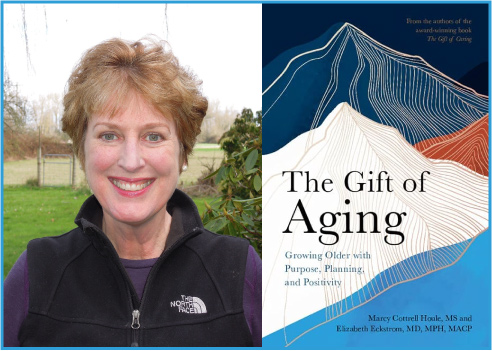
 Marcy Cottrell Houle spent many years caring for her aging parents as they endured numerous health problems. But it wasn’t until recently that an accident brought her face to face with the reality that she was getting older herself – and in order to do so with a minimum of complications, she needed to prepare herself physically, mentally, emotionally, and spiritually.
That epiphany set Marcy on a path to research and co-author a follow-up book to her Christopher Award-winning “The Gift of Caring: Saving Our Parents from the Perils of Modern Healthcare.” This latest work is titled “The Gift of Aging: Growing Older with Purpose, Planning, and Positivity,” and we discussed it recently on “Christopher Closeup” (podcast below).
Several years ago, while rushing from the Kroger’s parking lot towards the store’s entrance, Marcy tripped on a drainage gate and broke both her arms. This left her virtually helpless for several months, unable to do things like cut her food or tie her shoelaces. Thankfully, Marcy’s husband was able to take time off work to care for her, but the experience left her depressed and feeling like a burden.
That led her to contemplate the infirmities and medical conditions many people face as they get older – and whether there were ways to stay healthy. She decided to approach her “Gift of Caring” co-author, Dr. Elizabeth Eckstrom, Chief of Geriatrics in the Division of General Internal Medicine & Geriatrics at Oregon Health & Science University.
Marcy told Dr. Eckstrom that she would like to explore what it means to age well, with joy – and whether that was even possible. Dr. Eckstrom responded that she would love to research aging from a more technical standpoint, having to do with different parts of the body and diseases that can pop up in the lives of the elderly. And so, they embarked on a journey that led to “The Gift of Aging.”
Marcy noted that a study done at Yale showed that people who have a positive view of aging tend to live 7.5 years longer than people who don’t. She explained, “Many of us have a very negative idea about aging. It’s just going to be loss and frailty and dementia and burdensome. It doesn’t have to be that way. Yes…the people I interviewed did lose significant people in their lives, some had real health problems, some lost children…Yet, they could say they loved life, it had meaning, it was joyful. How?…There are things we can do to make life have joy until the end.”
One of the key factors to aging well is having a sense of purpose. While retirement and having fun sound appealing to many, human beings need more in order to thrive. “People who are doing the best,” Marcy said, “they’re the ones who are not just living for themselves. They’re living for the people coming after us, and they recognize our earth is hurting and people are hurting. And you can find such joy if you get out of yourself a little bit, get out of your aches and pains and say. ‘How can I make life a little better for someone else?’ That can make a big difference.”
As one example, there is 106-year-old Eleanore. She still makes time to volunteer and order food to be delivered to homebound seniors, who she sometimes visits herself.
There is also 97-year-old Rabbi Josh Stampfer. When Marcy met him, he was in a wheelchair, accompanied by a caregiver. Marcy expected his handshake to be frail, but he had quite a grip, as well as a personality that conveyed “dynamism.”
Rabbi Stampfer had spent his life helping Jewish people suffering in countries such as Russia and China. He had lost his wife in recent years and obviously suffered from some health issues. Yet he also still worked as a teacher and gave sermons on the radio. How did he accomplish all this at 97? He said he had learned that life needs a higher goal than joy.
Quoting Rabbi Stampfer, Marcy said, “In all of us, there is an innate need for happiness, but happiness is not just based on good health. Not everyone has that…What I have found – and suggest to others – [is that] the way to be happy is to be good. Being good will make you happier. When people do a good deed for others, they really enjoy life more. It’s very nice to have wonderful thoughts, but it’s also important to translate those thoughts either into deeds or into words. Bringing happiness to others is the quickest way to have it yourself.”
That idea feeds into the importance of community in healthy aging. The aforementioned Eleanore, for example, has become friendly with her grandchildrens’ and great-grandchildrens’ friends. Unfortunately, this is not the norm for many seniors in the U.S.
Marcy said, “Social isolation is an epidemic in our country, especially as you get older…The studies show that being isolated socially is as bad for you as smoking 15 cigarettes a day in terms of death and causing dementia…But our society is set up that people get isolated, [so recognize] you need to do something.”
In essence, if no one – be it individuals, churches, or community organizations – is reaching out to seniors, perhaps they need to take the first step and reach out to others, like Eleanore is doing.
Another factor shared by many of Marcy’s interview subjects is the practice of faith, which offers guidance to people in general and helps them move through the difficult seasons that life brings to everybody.
As an example, Marcy quotes the words of 102-year-old Lucille, who offered this bit of wisdom: “Each phase of life has its blessings, as well as its trials, so enjoy what you can now. As far as I know, this is the only chance we get. Old age isn’t so frightening. Do all you can to stay healthy, keep active both mentally and physically, then recognize that all things eventually wear out – and you will too. It helps to be able to laugh at yourself. Remember, death itself is just another phase of life. I’ve been lucky. I’ve enjoyed a long-lasting faith that provides a supportive community and a guide. I’m not sure what follows this precious life on earth, but my faith gives me not fear but a grand sense of wonder about it. In life and death, we have only to do one thing: simply let love in.”
To research the physical side of healthy aging, Dr. Eckstrom traveled to the world’s “blue zones,” where individuals live into their 100s in relatively good health. Marcy explained, “She went all around to see how they were doing it, and a lot of it had to do with connecting to your families, connecting with your community, having a purpose. She’s talked about in Italy, how people in their nineties would walk five miles on cobblestone streets and climb ladders to prune olive trees. She said you’d never do that here, somebody would fall and break a hip immediately. [But] that’s what they’ve always done. [Also], recognizing that eating really well is important, a Mediterranean diet. She stresses fruits and vegetables. And having connections and having a purpose. All those places had that going on, and I think that’s what can be hard here in the United States. So, she says to think about what we can do here to bring back some of those wonderful strategies to make our lives more like a blue zone.”
Marcy hopes that readers of “The Gift of Aging” are left with both practical and inspirational advice that will help them get older with improved health and a positive attitude. She said, “Bill McKibben, an author, wrote the Foreword, and I liked what he said. He talked about the legacy we leave. What kind of world are we leaving for those we love? And if you want to not be thought of as elderly, then act as an elder. It made me realize, these people [I interviewed] were given a gift of aging. They have made it into their seventies, eighties, nineties and hundreds, but they’ve made this time count. I thought, I want to make this time count too, not just living for me, but to make a difference. We have that opportunity. I think the world needs us.”
(To listen to my full interview with Marcy Cottrell Houle, click on the podcast link):

