
 Posted by
 With the sharp increase in racial tensions in the United States over the last few years, getting people to move beyond their hatreds and prejudices can seem like a hopeless cause. But CNN journalist John Blake offers a different perspective because he has experienced radical changes in himself and other family members from both sides of the Black/White divide.
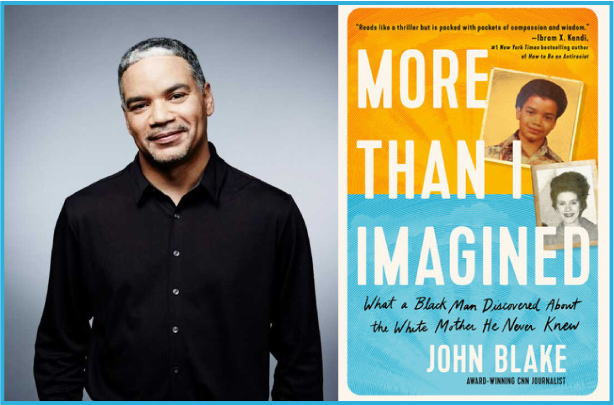
John shares his powerful story about racism, family, mental illness, healing, faith, and forgiveness in his new memoir, “More Than I Imagined: What a Black Man Discovered About the White Mother He Never Knew,” and we discussed it recently on “Christopher Closeup” (podcast below).
John and his brother, Pat, grew up in an African American neighborhood in inner city Baltimore during the late 1960s/early 1970s. Their father, who was Black, worked as a merchant seaman and was away from home for eight months of the year. As a result, the boys often found themselves in abusive foster homes because their mother was not in the picture. All they were told was that she was white, her name was Shirley, and her family hated Black people. This wasn’t unusual for an era during which interracial relationships and marriage were illegal in many states.
For John, the hatred went both ways. Though no one in his community specifically told him he should hate white people, “it was just something I absorbed like the humidity,” he explained. “It’s the conversations I overheard. It’s what I saw.”
John, therefore, never told anyone that he had a white mother, becoming what he calls “a closeted biracial person.”
During the dark times of John’s childhood, one person stood out as a shining light: his paternal Aunt Sylvia. He recalled, “I needed…that one figure who would accept me and encourage me and tell me that I was somebody. That person was my Aunt Sylvia. She was an unmarried woman who never had children. She worked as a secretary. To the eyes of the world, she was perhaps nobody…but she was like my lighthouse in the sea of chaos…She was that surrogate mom who helped me to believe in myself, who taught me the value of books, and taught me the value of faith.”
Faith wound up becoming an important part of John’s life, but he admits that he wasn’t a willing churchgoer in his youth. With Aunt Sylvia, however, he didn’t have a choice.
“She took us to a Black church, but it’s more like we were drafted,” he explained. “We had to go to church. For a lot of Black people, it’s very difficult to get into Christianity because we see these pictures of a white, blue-eyed Jesus, and we know that the Bible has been used to justify slavery and all that. I felt some of that tension when I would go to the Black churches…Yet despite that, there were these moments in church of tremendous spiritual power…I went to this church where a lot of blue collar Black people attended. Outside of Sunday, a lot of them were considered nobodies – blue collar workers, people who were dealing with discrimination, who grew up in Jim Crow. But when they came to church, it’s like they had this dignity and they had this love of God that even as a kid I could sense. It really impressed me. So…my Aunt Sylvia and some of those people I met in the Black church made God a little bit more tangible.”
At the age of 17, John’s life changed radically when his father asked him if he wanted to meet his mother. That moment is so burned into his memory that he even remembers “The Price is Right” was playing on the television at the time.
Three days later, John and his brother Pat were driven to Maryland where they entered “a menacing red brick building. It’s the saddest place I’ve ever been,” he said. “I could feel the misery, but I couldn’t quite put it together. I’m hearing people moan in pain in the background, while others are just laughing hysterically…[I learned] we were in the waiting room of a…notorious mental institution called Crownsville, and they were known for abusing patients. They would chain them to beds, subject them to medical experiments.”
After a little while, a hospital orderly brought a thin white woman into the room. Her eyes lit up when she saw John and Pat, and she exclaimed, “Oh, boy! Oh, boy! John and Pat, it’s so good to see you!”
It was their mother, Shirley. She hugged her sons, but John felt awkward, having never even used the word “mom” before. Despite the discomfort of the situation, that meeting resulted in several epiphanies for John.
“No one told us that our mom had this severe form of mental illness called schizophrenia,” he recalled. “We didn’t make that discovery until that day in the waiting room. Part of the reason they didn’t tell us is because they didn’t know how. People didn’t talk about mental illness. But what was significant about that meeting…besides meeting my mom, is that before I met my mom, I didn’t think that any white person could understand or empathize with what it meant to be Black, to grow up in a poor, violent neighborhood like I did, to be looked down upon because of nothing that you have control over. But when I met my mom, I thought, ‘Wow, I’ve never seen a Black person suffer like that.’ She began to shatter these assumptions about white people that I had in that meeting, without even saying a word. That was the first time that I developed empathy for a white person, that I began to see, ‘Well, they’re not all racists.'”
Before John left that visit, his mother made one request of him. She asked him to send her a St. Jude prayer book. At the time, he didn’t know who St. Jude was, but he soon learned he was the patron saint of hopeless causes for Catholics like his mom. She considered herself a hopeless cause and relied on St. Jude to help and guide her.
Beyond his mother’s situation, which improved in the ensuing years, St. Jude’s effectiveness seemed to extend to other areas of John’s life. For instance, some might consider those who hold racist beliefs, such as his mother’s family, to be hopeless causes. But John soon discovered the power of human relationships, how they can genuinely change people’s hearts and minds, and how Christian faith can serve as the motivating force for acting with mercy and humility.
John explained,”I’ve spent a lot of time in my life covering the worst racial upheavals in this country, going back to Rodney King, Charlottesville, Ferguson…[but] I have never seen such fatalism and pessimism about race/racism in this country [as now]. There’s so many people who believe that racism is just a permanent part of being American, that we won’t ever get past our racial divisions. One guy told me the other day that racism is embedded in our DNA.
“I have not seen that to be the case,” John continued. “What I have seen in my life – through my mom, through my mother’s family – is that people can change. I’ve seen people in my mother’s family who denied that they were racist – even though they used the N-word, even though they said that white and Black people should live apart – I’ve seen them change to the point where one of them…became this person who loves Black Lives Matter, who reads ‘To Kill A Mockingbird,’ who calls me to talk about John Lewis. I’ve seen people change. There’s a Scripture I’m going to mangle, but it’s in the New Testament where Paul talks about we’re all new creations in Christ. I do wonder, though, if a lot of Christians still believe that, because I don’t sense that, but I have seen it. People can change. Racism is not embedded in our DNA. That’s one of the things I try to show in my book.”
John also notes that he has moved beyond his own prejudices, acknowledging that the type of anger he felt as a young person was not healthy or conducive to living a good life. He explained, “I’ve had people tell me, ‘You’ve gotten over your anger,’ and I try to tell people, anger is healthy…in certain circumstances. We should be angry over injustice. We should be angry over people being mistreated. I don’t think there’s anything wrong with that. Jesus goes into the temple. When he clears out the money changers, He’s angry…What I think is really dangerous is when that anger morphs and becomes…this all-consuming hatred of all people. I had this anger toward my white family, but I also had this anger toward all white people as a kid growing up…”
“I vividly remember, just before I met my mom, I read this story in the New York Times about a Black man whose car had broken down in a New York neighborhood that was all white. A mob surrounded him and beat him to death. I remember reading that and becoming so angry, and I walked out onto my front doorstep in Baltimore, all Black neighborhood, and I asked myself, ‘What would I do if a white person came through my neighborhood?’ I concluded, I would have to hurt him, I would have to attack him. It’s that type of anger that I think is dangerous…Now, if you had told me at that time that I was being racist or intolerant, it would not even have made sense to me..So yes, I do think there’s anger that’s appropriate. Then, I think there’s an anger that becomes a hatred of all people that is definitely not appropriate.”
Perhaps the most unusual part of John’s story is that his relatives’ ability to turn away from their racist beliefs extends not only to this world, but the next. He wasn’t sure he should share these particular experiences in his book, and only did so because other people were present when they happened.
John elaborated, “My mother’s father was this hard drinking Irishman who really disliked Black people. He died without ever bothering to contact me, but in an odd way, he did contact me. Just to speed up the story, when I was a young kid, I was awakened one night and I saw an elderly white man half walking, floating through my bedroom, and so did my brother. We couldn’t figure out what this was. We were terrified, and we put that experience behind us…I never figured out who that person was, but later I found out it was my mother’s father. I thought that was the end of the story. Yet again, he began to visit again in two other situations that I described that also involved my wife, this time when I’m an adult.
“The important thing about this story to me is this,” John continued. “I saw my mother’s father as a monster. I knew what he did to hurt my father, but what I learned from that is that you cannot define people by their worst act, that he felt tormented by what he had done, that he could have had this relationship with me and my brother, that his racism prevented him from having this contact, that it bothered his conscience so much that he could not find rest even after he had died, that he had to make amends. So that’s part of the story. He wasn’t just coming back to terrify me. He was coming back to make amends. So in a way, he haunted me, but I haunted him.”
In the end, “More Than I Imagined” provides readers with a complex, nuanced view of humanity where our sins coexist with our virtues, and we can’t just put each other into a box of good and bad. We are each a mixture of everything, and we’re never quite the saints we make ourselves out to be in our own minds.
Along with that idea, John’s story also proves that we can all choose to become better than we are through love, humility, mercy, and by getting to know each other as human beings rather than stereotypes. Because none of us should be seen as a hopeless cause.
(To listen to my full interview with John Blake, click on the podcast link):
 Light One Candle - the blog of The Christophers