
 Posted by
 “Being less cynical ensures a happier life.”
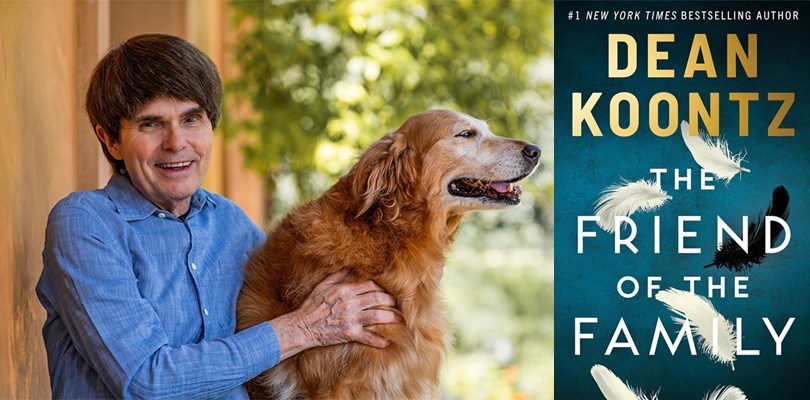
Best-selling author Dean Koontz made that observation in an essay on his website, but it’s an idea that has long found its way into his novels because he has experienced its truth personally.
Considering that Koontz was raised by a violent and abusive father, it would have been easy for him to become mired in darkness. But thanks to the positive examples of several people around him, as well as the characters to which he was drawn in the many books in which he found an escape from reality, Koontz embraced a more positive path, grounded in the belief that God created humanity and our world with meaning and purpose.
These themes are evident in Koontz’s latest novel, “The Friend of the Family,” about Alida, a teenage girl with severe physical deformities who is the star attraction of a carnival freak show in the 1930s. Alida is dehumanized by both audiences and the freak show’s owner until the Fairchilds, a compassionate, wealthy couple, adopt her and make her part of their own family with three children.
During a “Christopher Closeup” interview (podcast below), Koontz admitted that this element of the story developed as a bit of wish fulfillment on his part. He explained, “I fantasized as a child in a very poor family of maybe actually belonging in a rich family that has somehow lost track of me, and I ended up in this other place…And this is a very functional family, the Fairchilds, that this girl gets taken into, and rescued from the carnival. It’s great fun to write about functional people who enjoy one another, and have a sense of humor, and go through the vicissitudes of life because they rely on one another.”
Because Koontz is a master of suspense whose works have sold 500 million copies and been translated into 38 languages, danger is never too far away from Alida and the Fairchilds. Alida’s kind heart, however, becomes the heart of the story because Koontz doesn’t dwell on her deformities, but rather on the beautiful person that she is.
Regarding his approach to beauty, Koontz said, “The world was made, really, for our delight. Now, if we don’t use it that way, if we bring the wrong attitude to it, that’s not [God’s] fault. It’s our fault. And so, I like to write about characters who, even if their lives might have periods of darkness in them, relate to the beauty of the world and all of its manifestations. Alida is particularly drawn, as I was as a kid, to novels, to books as a way of learning about the world beyond her narrow little place. She lives within this carnival show…But through books, she begins to recognize the broader beauty and wonder of the world.”
Alida’s literary interests reflect the classic literature Koontz devoured as a youth, written by authors such as Jane Austen, H.G. Wells, F. Scott Fitzgerald, and his favorite, Charles Dickens. Regarding the latter, Alida says in “The Friend of the Family,” “Because of books, especially those written by the wonderful Mr. Dickens, I believed this was a made world with profound meaning. I kept faith that each of us has a purpose and that if we fulfill it, we will rise from even the lowest position as surely as a night mist rises from a lake in the morning sun.”
Alida also makes an observation about the lead character in Fitzgerald’s “The Great Gatsby,” noting, “[Gatsby] did not believe this was a made world with profound meaning or that he had a purpose greater than his own needs and desires. Had he believed as much, he would’ve understood that the only chance we have of being lifted ourselves is by lifting others. Although I was a biological oddity, a freak, I had been waiting all my life for the opportunity to lift others and thereby rise with them.”
Once again, Alida is echoing Koontz’s real-life views. The author said, “I’m fascinated with people who think life has no meaning because I look around and say, there’s so much meaning in every little event of the day. It’s a matter of opening your mind to it, of recognizing it. But I have, even people who’ve been friends over the years, who adamantly refused to acknowledge that part of life, and they think, ‘I don’t see what you’re talking about.’ I sometimes say, ‘You don’t see it because it’s slapping you in the face – and because of the violence of the blows, you’re keeping your eyes shut. But it’s right there.’…And so part of what I always wanted to do in the writing is touch upon that, hopefully not in a preachy way, but through character that shows you how these characters function better in the world when they recognize that aspect of it…The more you open yourself to all the wonder in the world, the more exciting and beautiful life is.”
Sometimes, people who were raised by abusive parents can take a dark path themselves. Koontz admitted that it was in his nature “to go completely off the rails. There were moments in my life when I could have done that.”
Thankfully, he had positive influences around him to offer some perspective. Koontz observed, “[When] you look around, you notice the people who are happiest, [they haven’t] always been about ‘me, me, me.’ I had some influential people in my life early on who had very simple lives in terms of their resources, but were very happy people. One of them was a high school English teacher of mine…She had been a sergeant in the Women’s Army Corps [in World War II], and she knew how to control kids, in a good way…Her thing in life was going to church, but also helping kids become more than they thought they could be. I had an uncle who was pretty much the same way, in an otherwise quite dysfunctional family…One of the great blessings is I married someone who has always had that stability about her, and that wisdom to know the right way and the wrong way…And I think it was those examples…that make that impact on you.”
Koontz added that someone being a bad example can also be beneficial if you recognize it as being bad. When faced with a moral dilemma, he would ask himself what his father would have done – then do the opposite.
“One thing that I saw with my father,” Koontz noted, “[was that] the wrong choice can work for a short while, but it never works for long. I saw that as a constant unfolding tragedy in his life. He was always on his way to a fortune – or so he thought. But he was always going about it in a wrong way, often at the expense of other people. And it would always go wrong sooner or later. That was a very good example. Evil works, but only in the short term. And we all want to be around longer than that.”
As an author who is a Catholic convert, Koontz is used to giving his villains offers of grace to change their ways. He did the same for his father, who developed health problems and could no longer support himself. Koontz flew his father to California and moved him to an apartment near him, believing he only had one year to live.
“In actuality,” Koontz recalled, “he lived 14 years. It was really a difficult and terrible 14 years in some ways, but it was a highly valuable 14 years in other ways…I get a lot of mail from people [who’ve] had the same kind of childhood, some worse, some better. One thing we all share is the feeling that [we had a] parent who never behaved like a parent. [They wonder if] there is something we could talk about that would explain it…I had 14 years of day-to-day care for my father with our roles reversed. And at the end of it all, I realized there was no way he was going to ever explain himself or to be different.”
“Consequently, ” Koontz continued, “what I spent so much of my life expecting was the wrong expectation. The right expectation was, it’s up to him to change if he wants to…There’s only so much you can do to help them find their way. And if they don’t, it’s a great sadness for everybody. But you can’t take personal responsibility for it to a great extent. It’s the person whose problem it is who has to be willing to solve it. And I’ve encountered so many people, readers who say, ‘I’m 55, I still am broken by all that childhood and I don’t know how to get past it.’ And I’m saying that – this is not a perfectly Christian way to get past it – but I would recommend this. If you’re going to let that person destroy your life, then they won. And you’ve got to say to yourself, ‘I don’t want that person to win. They’re not going to destroy my life.’ And that’s the best way you can deal with it…Everybody owns their own soul, and they have to decide what to do with it.”
(To listen to my full interview with Dean Koontz, click on the podcast link):
 Light One Candle - the blog of The Christophers