
 Posted by
 If the media you consume leaves you feeling emotionally exhausted, angry, or harboring an “us versus them” mentality, it will affect the way you think and act in the real world, to the detriment of society.
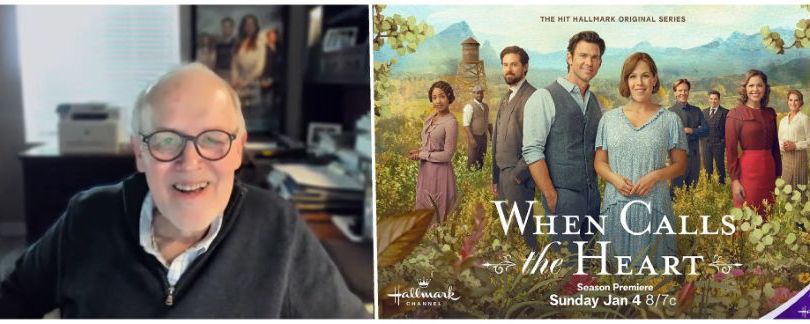
On the other hand, the Hallmark Channel series “When Calls the Heart” – currently in its 13th season – produces the opposite effect. With stories and characters that are often reflective of the Prayer of St. Francis, you can watch love sown where there is hatred, hope affirmed in times of despair, and faith awakened in periods of doubt.
As such, “When Calls the Heart” doesn’t just offer entertaining storytelling, but important and relevant storytelling.
During a “Christopher Closeup” interview (podcast below), the Christopher Award-winning series’ co-creator and executive producer Brian Bird explained, “In my own personal walk with God, I try to lead with love in all my interactions. That’s always playing in the background of my mind as I’m talking to anybody or working on projects: lead with love. And so, ‘When Calls the Heart,’ I think, that is sort of our watchword, too, for the show…There are characters that are important to the audience…but it’s really that community that to me is the biggest star, the community of Hope Valley….We hear from the audience all the time – I wish I could live there. And I feel like the show is an inoculation to the division that we’re seeing in our culture and in our society.”
“We see the show as soul food for people,” Brian continued. “That’s not a popular thing to do in my business, to provide soul food. They want to provide shocks or scares or anxiety…or drive people into corners where they feel like they’re suffocating. We don’t want to do that. That doesn’t mean we want to avoid real world problems…Sometimes it can feel that way to people, maybe, but we want it to inform their lives so that they can be encouraged to live a better life.”
One way to live a better life is to extend mercy towards others, even those who don’t deserve it. That has been a recurring theme throughout the series, but has been especially prevalent in season 13. For instance, the surly character AJ McGinty (Kevin McNulty), who has done some rotten things in his past, is on the receiving end of mercy and grace. The same holds true for Toby (Billy Christos Jr.) and Cooper (Elias Leacock), two teens who were at one point suspected of unintentionally starting a forest fire that burned down the neighboring town.of Benson Hills. Rather than condemnation, Maisie Hickam (Samantha Ferris), the mayor of Benson Hills, offered the boys understanding and forgiveness. And as Pastor Joseph (Viv Leacock) told Lee Coulter (Kavan Smith), “Mercy means the most when it’s hardest to give.”
Brian compared these instances to two sides of a coin, with justice on one side and mercy on the other. “But the whole coin is about grace, right?” Brian observed. “Because justice can also extend grace. Tough love can also extend grace. Mercy is the flip side of justice, but it also is bound together with justice, like the two sides of the Force in ‘Star Wars.’ The Force, in our case, is grace…And mercy is most associated with grace. It’s the idea of of forgiveness, a pardon. And this is a show of penance and pardons, often.”
That not only holds true for the characters on “When Calls the Heart,” but the actors as well. Brian pointed to the example of actress Lori Loughlin, who was one of the series’ original stars, playing Abigail Stanton, until she got in legal trouble with the college admissions scandal and served some time in prison. It was recently announced that after seven years, Lori would return to the show in season 14.”
That’s a case of real life mercy, real life grace,” Brian noted. “We love Lori. We love the character of Abigail…She faced justice and she looked it in the eye and she pled for forgiveness on the day of her sentencing…It got lost in the news. Not everybody heard that because it was all about the sentence, the news stories. She absolutely did plead for forgiveness. And so we love the idea that Lori’s coming back.” And though Brian didn’t offer any spoilers, he said the story of her return is “all being factored right now.”
In the context of “When Calls the Heart,” the series’ biggest redemption arc goes to Henry Gowen (Martin Cummins), who started as a villain, but has evolved into one of Hope Valley’s most reliable good guys with an edge. In season 13, however, Henry’s son Christopher (James Drew Dean) is faced with some difficult moral choices. Though the two characters had been estranged for some time, they had been building a good relationship. So, Henry offers support and guidance to help lead Christopher to making better choices than he did when he was young. But doing the right thing will also cost Christopher the life he had been building for himself.
Brian explained, “[Henry is] now reunited with Christopher, trying to be the dad that he never was. And yet Christopher was raised in the shadow of Henry Gowen, the unrepentant villain. For Christopher, he’s having to find out what being a man of righteousness is, discovering that within himself. That is no easy challenge for any of us, let alone somebody that was raised by wolves. So that is an unfolding storyline, which we love. Christopher’s engaged. That’s now in the crosshairs of the drama of the show, that engagement, but also his job. His own sense of right and wrong is in the crosshairs of the drama. So it’s unfolding quickly within the last couple of episodes and more to come.”
Another highlight of season 13 has been the addition of the character Gwen (Alex MacIsaac), a girl whose father was injured in the Benson Hills fire. The Coulters take her in to live with them until her father recovers, and Gwen and Lee quickly build a strong bond. Beyond even the excellent writing and directing of their scenes together, there is some transcendent magic that occurs whenever Smith and MacIsaac share the screen. Every scene is elevated, and you feel like you’re watching an actual loving and nurturing foster father and daughter relationship.
Being a foster or adoptive parent is especially important to Brian. He said, “We’ve adopted two children in our family, and my wife, as she was growing up, was a foster kid. And so, stories of foster care and adoption are deeply important to us. And Hope Valley never ceases to please me in how we tackle those issues and those topics. Even though it’s a hundred years ago, we still feel like they’re relevant for now. Part of the beauty of ‘When Calls the Heart’ is that we try to tell stories that have verisimilitude to the times, but they still resonate for now. The lessons we can walk away with and talk about from Hope Valley and from ‘When Calls the Heart’ are relevant to our lives in 2026.”
For longtime Hearties, of course, no question is more pressing than how the romance between Nathan (Kevin McGarry) and Elizabeth (Erin Krakow) will develop. Brian’s only non-spoilerish spoiler was that by the end of the season, fans “will be smiling and gasping…Gasping doesn’t mean a bad gasp. It’s a good gasp. They’re gonna be extremely happy – and surprised as well.”
(To listen to my full interview with Brian Bird – with additional details about the upcoming Hallmark Plus prequel series “Hope Valley: 1874″ and Brian’s upcoming documentary “The Story of Everything,” about scientific proofs for the existence of God – click on the podcast link):
 Light One Candle - the blog of The Christophers