 Posted by
 Deacon Don Grossnickle shouldn’t even be here anymore. Diagnosed with Stage 4 heart failure in 2016, doctors told him he would be dead within two years. Shocked by the unexpected news, Deacon Don set out to not only improve his relationship with God before he met his maker, but also to add more of God’s light and love to the world in his own unique way.
Both those goals have borne fruit, partially through two recent pilgrimages he took – and partially through the microfinance project he created to aid poor mothers and babies in Uganda. Deacon Don joined me on “Christopher Closeup” (podcast below) to share his experiences.
For the last 10 years, Deacon Don has gone to cardiac rehab five days a week to exercise his heart muscle and simply maintain the status quo. His efforts have worked since he has obviously lasted well beyond his predicted expiration date. “I was preparing to die – and have still been,” Deacon Don observed. “Every day is a blessing…In a way, I give all the glory to God. It is a miracle that I’m living. Most people say it’s because God has got work for me to do and I’m not finished yet.”
In light of all his exercise, the Chicago-based deacon was in good shape for the walking required when he took the opportunity for a family pilgrimage to the Camino de Santiago in Spain with his wife, daughter, son-in-law, and granddaughter. “We deacons are required to do an annual retreat, which is an opportunity, I think, to become reflective, inspired, motivated, and connected to what our Lord is guiding us to,” he said.
The Camino offered the perfect opportunity for that. And by choosing the shorter Camino Finisterre, the trip was not as physically demanding as the full pilgrimage trail would have been. It did, however, result in connecting with his daughter and her family in a better way, since they live in New York and don’t see each other often. “We talked about our faith life. We talked about God, which is not always easy in just phone conversations…We [visited] churches and [had] prayer time. So, it was heavy duty spiritual.”
A few months after that, Deacon Don participated in a pilgrimage to Poland with 103 of his fellow Chicagoans to visit a variety of shrines, churches, and holy places. Deacon Don noted that he learned about “the larger context of how Poland has risen from the claws of communism. I came back tremendously inspired, maybe even with some saintly powers, greater than what I approached the trip with…It opened doors to me, giving me great spiritual strength…When Maximilian Kolbe or St. Faustina or John Paul II were down, the Spirit empowered them more. The great question, of course, is how do saints do it? I think visiting their sites, knowing their stories from birth to their spiritual formation and vocational development, I could see myself in them. If they can do it, we can do it.”
Despite his 77 years of age and 38 years in ministry, Deacon Don admitted that, spiritually speaking, “I was a juvenile and I’m still learning so much and growing and so humbled.” That especially held true for his trip to Auschwitz, where he learned the details of St. Maximilian Kolbe’s sacrificing his life for a fellow concentration camp victim.
Regarding this part of his pilgrimage, Deacon Don said, “I was struck in disbelief, particularly with Birkenau. Auschwitz was small in comparison to the 20,000 that were interred in makeshift buildings, living among themselves on the way to certain death that they didn’t really know or understand. It was shocking. I was very heartened with the idea that God gave me the potential to go there and look at what racism or discrimination can do when it goes wild. [It] empowered me and my preaching, maybe to be more open, to caution the world that each of us have an impact, basically to halt, each in our own way, that kind of discrimination, whether it’s in the US today with immigration issues or with discrimination going on in the world today against Jews. It had the impact, I think, of really inspiring and motivating, but it was deeply saddening.”
Sadness and empathy are what inspired perhaps the greatest mission of Deacon Don’s life: the Microfinance Alliance Africa Projects Foundation (or MAAP Foundation).
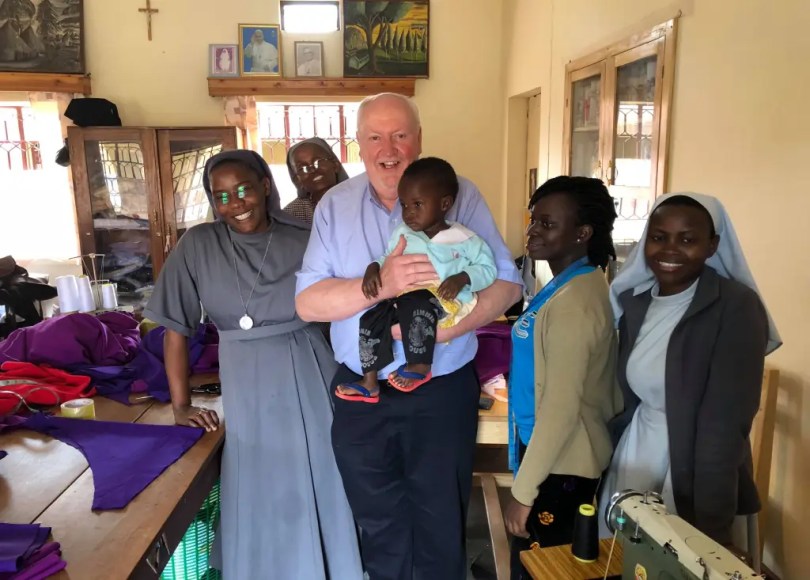
During a trip to Uganda, East Africa, to celebrate the ordination of a seminarian who had worked in his Chicago parish, Deacon Don came upon a maternity clinic that broke his heart because so many mothers and/or babies were dying for lack of care. After he returned to the U.S., he asked God what he could do to help these people. At first, he collected and sent over money for “malaria medicine and also medicine to pay for baby deliveries. Just $10 to $20 is all it requires.”
Deacon Don credits the Holy Spirit with leading him to the concept of “sustainability” and “microfinance” as better options: “The Africans are all busy with microfinance. Everybody grows to eat…If you have an excess, you sell it [to raise money for what you need], and that’s microfinance.”
Deacon Don shifted his attention to raising sums of $5,000 so the people in this particular Ugandan community could set up small cow, pig, or poultry farms that could earn $200 to $300 monthly. Profits could go towards their clinics, making them self-sustaining.
“It became a community development project,” Deacon Don explained. “The original clinic that I visited grew and grew and outlived its problems of bankruptcy and became financially strong. After that, we said, ‘Can we do this somewhere else?’ And we did. We’ve been doing that ever since for impoverished Catholic-oriented parish clinics. This year, we’ll be adding 10. We have 43 projects so far. The Holy Spirit has really empowered us.”
Deacon Don then shared the story of “Justine, who died on the way to the hospital [to deliver her child]. Justine and her unborn baby didn’t get to the parish clinic in time. The priest that was taking her to the hospital didn’t get there in time. Consequently, the priest that buried Justine and the baby came to us. We did a $5,000 project, and today, 10,000 people in his parish now have the opportunity to come and get free assistance to deliver babies. Justine had bleeding, and it’s very common in the rural areas of Uganda to have bleeding complications. Without expertise, they will die. There are no such things as doctors in rural parish-run clinics. So it’s a great story, a memorial to Justine and the priest that reached out to us….It illustrates the power of people to make change, to light a candle from darkness.”
When asked how he himself lights a metaphorical candle when facing times of darkness, Deacon Don concluded, “I light it through prayers of gratitude. Some people count sheep. I count opportunities that I have grasped with the Holy Spirit together, side by side, just as Jesus sent out His disciples two by two…There’s great joy in counting our blessings of opportunities to bring light.”
(To listen to my full interview with Deacon Don Grossnickle, click on the podcast link):
 Light One Candle - the blog of The Christophers