
 Posted by
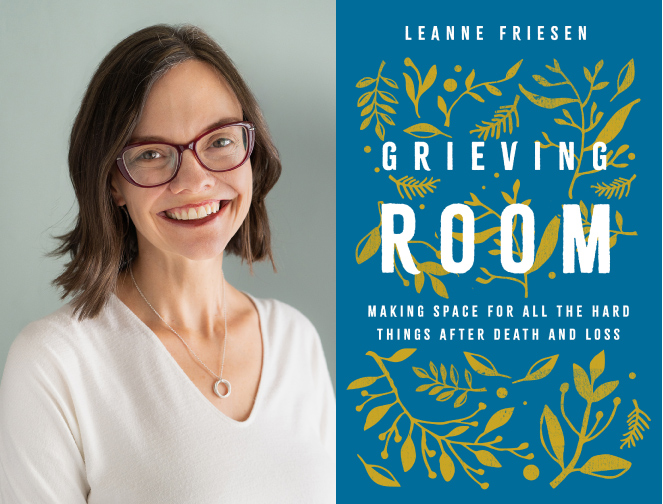
 As a pastor in Ontario, Canada, Leanne Friesen had studied bereavement and counseled many people dealing with the loss of loved ones. But when her sister Roxanne died of skin cancer, Leanne encountered an overwhelming grief she wasn’t sure how to handle. She learned there is no easy way to process grief, but that there are choices that will eventually move you through the darkness towards the light. Leanne shared her insights in the Christopher Award-winning book, “Grieving Room: Making Space for All the Hard Things After Death and Loss,” and we discussed it on “Christopher Closeup” (podcast below).
Following Roxanne’s death, Leanne felt like she was encased in a “grief bubble…I was living sort of separate from the world and…seeing everything in my life through this lens…For me, it was so hard to figure out what it meant to let my grief have a space…I wanted to say her name. I wanted to talk about it. I wanted to say I was sad. I wanted to be a mess…Looking back, I could see, grievers want their grief to fit somewhere, and we don’t really know how to make it fit.”
While people were supportive of Leanne’s grief during the early days, they had mostly moved on a few weeks later, whereas Leanne had not. And when someone did ask Leanne how she was, she was too embarrassed to tell the truth, so she made “I’m hanging in there” her default answer. Then, she would walk away thinking, “Why did I just lie? I don’t feel like I’m hanging in at all. I feel like I’m a complete disaster.”
Leanne learned to offer grace to the people in her life because they were not thinking about grief constantly the way she was. She noted, “I did learn to start finding some safe people…that I really felt like I could lean on. I started to learn that I had to name what I needed and ask for it and say things out loud. I started to learn that…no one was going to be all things to me. Some people might be good to talk to about some things. Some of my friends couldn’t talk at all, but they might be good to go for a walk and take my mind off it. Or they might be good to tell a funny joke and get me laughing when I needed it. So, letting people be different things was important. And eventually, I did find a counselor that I talked to…[We need] the space to talk.”
For those who want to support someone who is grieving, Leanne recommends mentioning their deceased loved one by name. She understands that people often avoid doing this because they think it will upset the griever by making him or her think about their loss. The truth, however, is that he or she is already thinking about it. Mentioning their loved one by name at the appropriate time and place can be a balm to a griever’s soul, serving as a sign that their loved one is still remembered.
And Leanne has many happy memories of Roxanne. She recalled, “[Roxanne] was extremely social. She always had people at her house. If you were new to town, if she met you at church, within a couple weeks, it was, ‘Come over to the house.’ She was always wrapping people into her world…She was a special needs teacher. She went into teaching right out of university and felt very deeply called to work…with children who had very severe developmental disabilities, children who often couldn’t walk or talk. She loved those kids so much. So, she made an impact in her world and left a void when she left.”
As a pastor, Leanne also had to navigate the unfairness of life in the aftermath of Roxanne’s death with belief in a good and loving God. “Initially, I was asking a lot of those hard questions,” Leanne noted, “and it’s so normal to ask those questions. I have a chapter of the book, I call it Room to Reconsider…[your] faith that was very black and white and made sense. [Like], if you pray this happens…and this is what happens to good people, and good people don’t have these things happen. And I had to live with a whole lot of those things that shake you a bit. My sister was a person of faith. She prayed all the time to be healed. Her church had prayer meetings for her where they’d all gather…to remember her in prayer and lift her up…It’s one of those deaths…that was really hard to make sense of. This is a special needs teacher who teaches Sunday school and has nothing but good to offer the world, and what on earth is the logic of this woman dying?”
“Initially I had those questions, and I felt at peace with the not-knowing and not understanding. I think I’d wrestled with those theological implications as a pastor after burying many people…But I do tell the story in the book that just a few months after my sister died, my father and my two nephews (my other sister’s two sons) were in an absolutely catastrophic boating accident…My dad had broken his back. My nephew, who was 16 at the time, was in a coma. He had a blood clot in his brain, he’d just had brain surgery. They didn’t know if he’s ever going to wake up. My 14-year old nephew is in ICU with life-threatening injuries…And I remember saying, ‘God, I did real good the last four months. I haven’t yelled at You. I have stayed faithful. I haven’t talked about how unfair this is. And that has been sincere. But this is unreasonable.’ I was looking at the heavens and going, ‘Are you kidding me, God? This is too much for this family!'”
Leanne, her family, church community, and friends prayed for healing. And this time, it came. Thankfully, everyone recovered remarkably, and they are doing well today. “I have no idea why God answered one prayer in the way we wanted and the other in a different way,” Leanne reflected, “but I believe God was listening at both times.”
The mystery of why things happen the way they do is an idea Leanne feels comfortable with. She explained, “I believe Roxanne is fully healed with God now…And for me, I understand why, at that moment, that does not feel good enough, that you will want them healed with us. But I have learned to say – and feel comfortable saying – ‘There are things I do not understand.’…That was part of reconsidering [my faith] because I was raised in a very evangelical tradition that liked clear answers. Letting go of clear answers was important for me. But it was also then leaning on what I did experience to be true of God, which was as mysterious as – I’ve never felt God any closer than I felt sitting at my sister’s deathbed, and I was so certain He was there. That will remain as true to me as any other clear answer that I have. I’m sure someday it’ll all be made clear.”
One thing that was clear early on is how simple acts of kindness can make a difference for those who are grieving. Leanne recalled rushing to the airport shortly before Roxanne’s expected death so she could travel to Newfoundland and be with her in her final days and hours. A friend had gifted her the flight, which was generous and deeply appreciated. Leanne, however, felt the need to get on an earlier flight, so she pleaded with the agent at the gate, “My sister is dying!” The agent compassionately accommodated Leanne’s request.
Talking to herself, Leanne then commented that she’d have to buy dinner so she wouldn’t be starving when she reached Roxanne. After the plane took off, a flight attendant brought Leanne a meal. She recalled, “These are meals that you have to pay for, it wasn’t first class. And this flight attendant gives me this meal and a snack. And I go, ‘I didn’t buy a meal.’ And she goes, ‘It says here on your ticket: passenger gets a free meal.’ And I could cry thinking about it now. I know that [agent at the gate] put a little note [in the computer] to give [me] a free meal. I cannot tell you what that meant to me…There was something in that moment that made me feel so seen when I felt so lonely on that flight and so bereft and lost.”
Though it took a lot of time and effort, Leanne has reached a place of, what she calls, “resurrection hope…What I mean by that is the idea that…when someone you dearly love dies, it doesn’t just feel like they died. It feels like everything around you is dead. Your hopes feel dead. What your future looks like feels dead…Theologically, as a Christian, it’s also room to believe in Roxanne’s resurrection one day…But what I mean for that in the here and now is room for new life where you’ve thought there couldn’t be new life. Room for you to have hope. Room for you to have joy again. Room for you to find things that bring you delight again. Room for you to laugh again…Room for you to remember [your loved one] and [have] it feel bittersweet and not just bitter.”
For those who read “Grieving Room” – and for anyone dealing with grief in some capacity – Leanne offers these hopes: “If you’re in the very early phases of grief, I would say please be gentle with yourself. You’re not going to fix it anytime soon…Wake up and do the things you have to do. Get help where you can, say yes when people offer help, and let yourself grieve…As you get later into grief, maybe it’s been some months or years, continue to find that place to talk. It’s never too late. It’s not too late to tell people you’re grieving.”
“[For the people who want to support those who have lost someone], a really simple tip is: instead of trying to think about what will make a griever feel better, think about what will make them feel loved…When we go to the funeral home…or we’re meeting them after they return to work, [we think], ‘What can I say…so they feel better?’ So we say, ‘They’re in a better place,’ or ‘At least you had a long time with them.’…Often those words will actually be more frustrating than helpful because they’re…going to sound trite, and they’re probably not ready to hear them. If you let go of trying to make them feel better…and say, ‘How do I make them feel loved?’ I think you’re going to go in the right direction.”
(To listen to the full interview with Leanne Friesen, click on the podcast links below):
 Light One Candle - the blog of The Christophers