
 Posted by
 Shortly after her abusive marriage ended in divorce in 1981, Judy Henderson started dating a man she believed to be kind, God-fearing, and a positive influence on her two children. In retrospect, she realizes that she ignored several “red flags” about him that seem evident now, but didn’t register back then. As a result, Judy learned the hard way that the man she had fallen for possessed a serious dark side, one which ended up getting her convicted of a murder that he committed, while he got off scot-free.
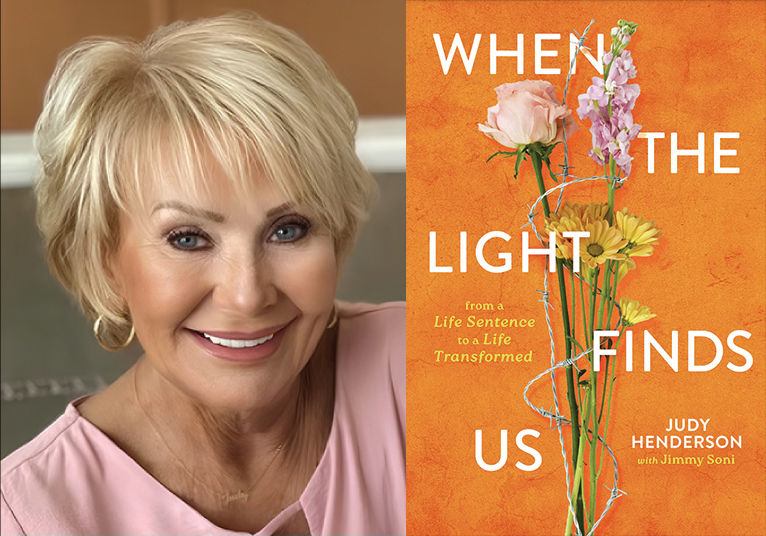
During her 36 years in prison, Judy worked hard at becoming “better, not bitter,” growing in her relationship with God and serving as a light to her fellow inmates. She shares her story in the memoir “When the Light Finds Us: From a Life Sentence to a Life Transformed” (co-authored by Jimmy Soni), and we discussed it recently on “Christopher Closeup” (podcast below).
Judy’s early life laid the groundwork for her relationships with men. Her father was physically abusive to her mother, her siblings, and her. When her mother sought guidance from their minister about the problem, he told her to just “pray about it.” In addition, an assistant pastor sexually assaulted Judy in her youth. Coupled with the fact that this was a “fire and brimstone” church, Judy was left with an image of God as “cruel.”
Later, in her 12-year marriage, her husband would get angry and violent whenever she asked him questions because he interpreted that as her accusing him of something. “I was just passive,” Judy explained, “and it was learned behavior. You don’t ask certain things, you don’t ask questions, you just go along with what it is. And being a battered woman to begin with, I wasn’t aware of battered women’s syndrome. That was something back in those days that you didn’t discuss outside the home.”
When Judy met Greg shortly after her divorce, he came across as the opposite of her former husband. “What I saw was this gentle man that was kind to my children,” she observed. “He didn’t curse me, he wasn’t mean to me. He wanted to know everything about me, even about my battered years of abuse for 12 years – not thinking that was something that he was going to use to manipulate me to do what he wanted me to do.”
One of the red flags Judy referred to happened at a family pool party when her aunt asked her why Greg was sitting there reading a book about manipulation. Judy rationalized that he was in real estate, so he was just trying to get good insights on making deals. Judy also didn’t ask questions when Greg brought strangers into their home or her business because she had been conditioned in her first marriage not to be too curious.
“The woman I am today is not the woman I was then,” Judy said. “I found out during my incarceration that…you don’t have to be addicted to drugs, alcohol, gambling. My addiction was love…My therapist and everybody said, ‘Judy, these are things as a little girl that you should have been experiencing. You should have been experiencing people loving you, but it was the wrong way of loving you.’ And so, whenever [Greg] was kind and nice and didn’t try to abuse me or hurt me in any way, I took that as a great sign. And it wasn’t.”
Judy was in the car when Greg committed murder, then he forced her to go on the run with him. When they were eventually caught, he convinced her to use the same lawyer he had to defend herself. Having never had any experience with the law of any kind, Judy went along with this, which ended up costing her her freedom.
“That caused a serious conflict of interest, constitutional-wise, and the fact that I could not testify against him. I could not say anything that would implicate him because the attorney would lose him as a client. The attorney already had instructed me prior to this, before the trial, that I could not take the stand unless I was willing to come up with an alibi testimony. I refused to put my hand on the Bible and tell a lie. Even though I was angry at God, that Bible still was very, very important to me.”
While Greg suffered no consequences, Judy ended up sentenced to life in prison. Though she had always been a soft – and soft-spoken – person, she had no choice but to become tougher because of the inmates and environment she encountered behind bars. Judy’s circumstances left her understandably angry, but that changed over time.
Judy said, “There’s two things you can do with anger…You can either get bitter or you can get better. I chose better because everybody in the prison was angry. Nobody cared that you were angry. The only person I found out you’re hurting is yourself. So you can take that anger and that animosity that you feel, and put that towards something better, use that anger to fuel you. Between that and the combination of the deep love I had for my children and my family, they motivated me to do everything that I could…to learn the law, to learn politics, to learn what got me there, how I ended up there. These are things I had to really soul-search about.”
Judy’s soul found its own new life after she attended a three-day Catholic Charities retreat that she resisted going to because of her resentment towards God. That resentment was melted by the love she received from the workers running the retreat.
“God became so real,” Judy explained. “I saw how they brought us food, they brought us all kinds of understanding. They didn’t care what we were there for, they didn’t even want to know…But when they washed our feet, that moment changed my life. Here they were kneeling down to me, and showing me a love that I hadn’t known in a long time. I think that made me realize that this is the love I had been looking for, searching for, all my life: the God love. To fall in love with God, to fall in love with Jesus, to do His work, to do what He created me to do. If it took this journey to get me to that point, then I was willing to walk it and learn what it was I needed to learn.”
Judy’s desire to help her fellow inmates began in a simple way. As a professional hairdresser, she started doing their hair and makeup, which led them to feel better about themselves. Then she became a fitness trainer to help them get in shape and get any drugs out of their systems. She also earned certification as a paralegal, who appealed for – and often won – clemencies for them. She taught incarcerated mothers how to talk to their children and break the “generational curse” of abuse and crime which led them to prison in the first place.
“Then,” Judy recalled, “I had to start battered women’s groups to help women realize that they were battered women. We had to build them up, and not break them down like they do whenever they come to prison. But I always kept this verse above my cell mirror that said, Jeremiah 29 11, ‘I know the plans I have for you, a future, not to cause you harm.’ I knew that prison is not where God wanted me to be. This wasn’t His doing. These were my choices, and I had to be responsible for these choices because God didn’t put me here. He wasn’t the one to blame for this. Satan was trying to kill, steal, and destroy. I think I got so angry in such a good way that I was going to beat him at his own game.”
Though it took 36 years of appeals by Judy’s attorney, Bob Ramsey (not the lawyer who represented her at her trial), she finally won her release in 2017 when Gov. Eric Greitens commuted her sentence after reviewing the details of the case which, even the original prosecutor, came to see as unjust.
“[Bob] was my attorney for 34 years and got to see me walk out. He did it all pro bono because he really believed in me. God sent him to me, and God just kept sending people into my life to build such a strong team. I would work with politicians in the visiting room to create new laws. We created a battered women’s syndrome defense law. So, I was able to be involved with that. God had a lot for me to do in there.”
Some time after her release, Judy gave a talk at Catholic Charities of Kansas City-St. Joseph. The CEO offered her a job then and there because she had such a positive spirit that lacked anger or bitterness. Though Judy hadn’t been looking for work, she accepted the offer because she now gets to continue serving God through serving others.
Judy hopes that readers of “When the Light Finds Us” are not only absorbed by her compelling story, but that they embrace its message of loving God, loving your neighbor, and pursuing redemption and second chances. She concluded, “People create their own prisons out here, I’ve noticed. It doesn’t have to be steel bars. Don’t let the enemy do that to you. Don’t let the enemy steal your joy. The best way to get joy is by helping others. And when you help others…good blessings come to you all the time.”
(To listen to my full interview with Judy Henderson, click on the podcast link):
 Light One Candle - the blog of The Christophers