
 Posted by
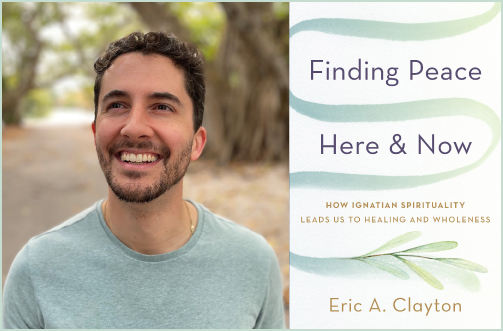
 When Americans ponder the prospect of pursuing “more,” it often has to do with material goods, money, or power. But in the context of Ignatian spirituality, “more” – also known as the concept of “magis” – leads down a far different path towards peace, gratitude, and the spirituality of curiosity. Author Eric A. Clayton explores these ideas in his latest book “Finding Peace Here and Now,” and we discussed it recently on “Christopher Closeup” (podcast below).
When you’re writing about inner peace, it can help to have experienced its opposite. Eric certainly did many years ago when he spent a year in Bolivia doing postgraduate service. with children. The term “compare and despair” exemplified his time there because he constantly compared himself to the other volunteers and found himself lacking.
Eric recalled thinking, “My Spanish isn’t as good, I’m not as gregarious and extroverted, I’m not as clever with icebreakers. So, I had a great list of the things I wasn’t, I never spent the time to think about, ‘Well, what am I? What am I able to do here?'”
An idea which helped Eric counter this mode of thinking came from his longtime spiritual director, Father Jim Bowler, to whom he dedicates this book. “[He] introduced me to the idea that God delights in me, that God looks at me as beloved, which was just revolutionary,” Eric said.
Accepting this concept can be difficult for many, Eric believes: “That sense of being beloved for simply ‘being’ is so countercultural and foreign to us, who feel like we have to do and produce and earn and succeed…It’s a lot easier to count our mistakes…than it is to say, ‘You know what? I’m doing good, I’m the beloved of God, and I can live out of that joy and out of that delight.'”
Living out of that joy and delight can serve as the cornerstone of inner peace, which we can then spread outward. The Spiritual Exercises of St. Ignatius can help because they lead us to ask and answer the question, “What are we made to do? We’re made to praise, reverence, and serve God, and in so doing, help ourselves and help others.”
This is where “magis” fits in, explains Eric, because the “more” we are pursuing is fundamental to who we are as human beings and children of God: “How we go about praising, reverencing, and serving God, that’s a unique question for us, for our vocation…That’s a question of looking at my own experiences, my own skills, my own passions, my own desires, and bringing that into the world. So, the way that I think about the magis is, how can I go deeper into myself to share more of myself with the world? To better understand, what is it that makes me tick? Why am I so animated about whatever it might be? About writing, or about science fiction, whatever it is…This is a wonderful quote from Pierre Teilhard de Chardin, a French Jesuit: ‘The more we descend into ourselves, the more we encounter God at work.’ He goes on. But I like that imagery [that] there’s always more to discover of ourselves. And the more we discover ourselves, the more we discover God at work in our stories… And the more we can do that, then the more we have to give to the world…Real success, in the eyes of God, isn’t an acquisition of more money and honors and pride, but in fact, an engagement with the world around us.”
Eric regularly engages with the world in various ways. Several years ago, for instance, he traveled to Amman, Jordan, to interview war refugees from Iraq, Sudan, and Somalia, whose inner peace had been destroyed by acts of violence which upended their lives.
“You could almost hear the gunshots in the background of these people’s stories as they’re sharing with you,” Eric recalled. “If anybody has the right to be bitter and to hold a grudge, it’s these folks. And in their telling of their stories…you can see that they began, quite understandably, bitter and mistrustful of others. But as they entered the Jesuit community that was there at the time, the Jesuit Center, and came into contact with folks from all over the world, something softened within them.”
One person in particular stood out to Eric, a young man he calls Amani. Because of his circumstances, Amani arrived ” hating people of Arabic background, hating White people, and hating people of other religions.” Everything began changing for him when one of the Jesuits encouraged him to take a dance class. Amani agreed, only because he wanted to change his mood and routine. It turned out he was a good dancer and soon moved on to teach dance classes. As he got to know the Jesuits and his fellow refugees on a personal level, his hate began melting away, and he regained the inner peace which allows him to build outward peace.
“When you dance with a group of people,” Amani said, “you can just see yourself, like you’re in a party. It’s very good to dance with people of different nationalities…We just see ourselves as human beings.”
This experience reminded Eric that God doesn’t just delight in us. He also weeps with us when we endure suffering, as evidenced in the Scripture verse, “Jesus wept,” following the death of his friend Lazarus..
” And then,” Eric points out, “Jesus gets up…Jesus draws very near to those who are suffering. So, what does that mean for peace and for how I think about it? I think it means that we’re allowed to be upset. We’re allowed to lament, and we’re allowed to cry and wonder, ‘What is going on?’ That’s a very viable and understandable form of prayer, and probably really important to any work of peace.”
On the other end of the spectrum, joy also paves the way to peace, but it demands “specificity” and “gratitude” to be effective, said Eric. He recalled a conversation with Jesuit author Father Mark Thibodeaux, who has written several books about the Examen prayer and why it needs to begin in a spirit of gratitude. That didn’t make sense to Eric because some people are trying to pray with the hardships and injustices in their lives. Why would they be thankful?
“We begin with gratitude because it lifts our horizon,” Father Mark responded. “Instead of spiraling and focusing just on the problem, we say, ‘God is still here. God is still at work. There’s still good here, and we want to see it all.'”
Eric saw the wisdom in that approach, explaining, “From that position of beginning with gratitude, there’s still blessings and graces here, then we can better address the problem. So how do you bring joy into it? You say, ‘What are those little things that keep us going?’…Somebody shares a smile, the flowers are beautiful today, this bird is doing something crazy and it’s really making me smile…Those little things is where God meets us. In the specificity, in the seemingly mundane, God meets us there, and I think that’s all we have to share with each other. We have these big, great, sweeping concepts of peace, but peace happens interpersonally. It happens when we share something of ourselves.”
All of these approaches work better if we adopt what Eric calls “a spirituality of curiosity.” That involves looking at the world and the people around us not in judgment, but rather in “wonder and awe.” We ask, “I wonder what’s happening in your life. I wonder what makes you tick. I wonder about those specific seemingly uninteresting stories that make up you in this moment.”
“We used to [say] fear of the Lord was a fruit of the Holy Spirit,” Eric continued. “When I was young, fear of the Lord became wonder and awe. And I like that, because of course we’re afraid of God, because God can do such great things. But it’s not that we’re supposed to cower; we’re supposed to embrace, to be curious about God’s creation. And we are God’s creation, so we’re not just curious about what the butterflies are up to, but we’re curious about what we are up to? What is my neighbor doing? Why are they sad? Why are they weeping? Why are they joyful? Be curious. It’s hard. Getting back to what we were saying in the beginning, it’s so much easier to count our sins, mistakes, and shortcomings, for myself and for others. It’s much harder, but much more enlivening to turn with curiosity – asking ‘I wonder what this person is up to’ – and be in awe of them and all that God is up to in the world. I think that’s the foundation for peace.”
(To listen to my full interview with Eric A. Clayton, click on the podcast link):
RELATED: Eric Clayton on St. Ignatius, Cannonball Moments, and the Spirituality of ‘Star Wars’
 Light One Candle - the blog of The Christophers