 Posted by
 Never before in history have we been inundated with as many media choices as today. From TikTok and Instagram to TV, movie, and music streaming services, the amounts of news and entertainment competing for our attention can be overwhelming and disorienting to our hearts, minds, and spirits. Sometimes, the healthiest solution is to step away from it all for a while.
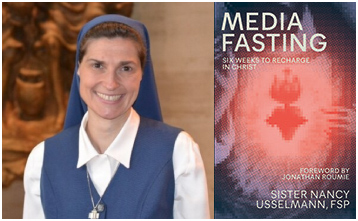
As a Daughter of St. Paul and the Director of Pauline Media Studies in Los Angeles, Sister Nancy Usselmann’s work often focuses on media literacy, but she has also explored how people can come to control their media consumption instead of letting it control them. Her book is titled “Media Fasting: Six Weeks to Recharge in Christ,” and we discussed it recently on “Christopher Closeup” (podcast below).
One of the great things about Sister Nancy is that she approaches media not as a scold but as a fan, having grown up loving books, films, and TV programs. The fact that the Daughters of St. Paul use media to teach about Jesus and communicate gospel principles is what drew her to the order. “We need to be able to look at our media culture and integrate our faith with it and not keep it separate,” she noted.
The one film in particular which awakened Sister Nancy to the moral and spiritual dimensions in secular storytelling was “The Shawshank Redemption.” She explained, “I was a novice when I watched it, and I remember [thinking], ‘Wow, this has a lot more to say about life, about the human person, about the possibilities for redemption, for hope.’ These stories can help us go deeper in our faith experience. So, that was the turning point for me, wanting to study a little bit more on media education, media literacy, and…integrating theology within our popular culture…We review…secular films and try to look deeply at: What does it say about the human person? Does it support human dignity? What are the theological themes that are being drawn out regardless of whether Christ is mentioned or not?…What are the values that it communicates?”
With the advent of digital technology, our media consumption no longer consists solely of going to a movie theater, watching TV in the living room, or popping a CD into the stereo system. These things are now with us 24 hours a day through our phones and tablets. Then, when you add social media to the mix, our behaviors can become even more addictive.
“Twenty years out from social media’s invention,” Sister Nancy said, “we’re considering now, especially for children and teens, that it can lead to greater depression or a separation from others where we’re isolating ourselves. It can lead to sadness, to anxiety. It’s time to pause and question, ‘How am I using these media?'”
That question came to a head for Sister Nancy when she was giving a talk to college students at UCLA. A young woman approached her afterwards and said she had tried fasting from Instagram for Lent. When Sister Nancy asked her how it went, the student admitted she went right back to her old patterns on Easter Sunday.
“This is a problem,” Sister Nancy explained. “So, what do we replace it with when we do fast from media? And then, how does it change us so that when we do go back to it, we do so with intentionality, we do so with authenticity, and we do so with much more spiritual focus? Because we’re inviting Christ into our media experience. Especially when we’re doing a fast, it’s really a spiritual experience. It’s not only for health reasons or emotional reasons, but mainly because we want to deepen our relationship with God.”
Sister Nancy wrote “Media Fasting” to help young people – and people of all ages – do just that. And she doesn’t approach the topic as an outsider, but rather as someone who has faced this problem herself. She admits, “My downfall is Instagram Reels. I keep on it, and I do not realize that 30 minutes to an hour have gone by. You’re watching…funny reels. They’re creative reels, they’re amazing technology, but they can be a time sucker. You’d just be absorbed without realizing the time that’s gone by. I think that’s the key. They’re created to be that. They’re created to keep your attention, but we don’t have to be controlled by it.”
Sister Nancy makes it clear that she doesn’t consider social media a bad thing. What matters is how – and how much – you use it. She and the Daughters of St. Paul create their own posts and reels “to give inspiration and hope and light and joy to people, helping people to recognize that Christ is with them and Christ desires a relationship with them…These are technologies that God has allowed human beings to create. They’re fantastic for sharing information and entertainment, but we also have to find when our brains and our souls need a little silence from all the digital noise.”
In the book, Sister Nancy introduces readers to a variety of ways to engage in a digital fast because it can differ according to what each individual needs. For herself, she created time limits to keep from spending too much time watching Reels. Some give up watching the news. Others fast from social media for a weekend – or for several weeks. As the book’s subtitle states, Sister Nancy offers a plan to take readers through a six-week fast if that’s what they think they need.
“Try to eliminate that one element that’s causing you the most trouble,” Sister Nancy recommends. “Then, what’s important is to consider, what will you replace that time with? Can it be a little bit more time for prayer? Often we’re saying we don’t have time to pray. Well, maybe that’s the moment. Honestly, 10 minutes of prayer a day can be truly transforming…Also, how do I reflect upon all my media use, so that when I do go back to it after the fast, I do so in a different way…I cover in the book different things, such as video games, music, social media, film, TV, everything. How do we pray through our media experience, so that we can live our relationship with God in every moment of every day? That by inviting Christ into our media experience, it’s going to challenge us to think about, ‘What am I watching? What am I engaging with and why?’ Consider, ‘Hey, invite Jesus to watch it with me. Would I feel comfortable with that, thinking about this?’ So that’s what the book is. It’s offering the spirituality for a media experience. There’s a lot of secular media fasting out there, but this offers a spirituality, a way of living it while integrating it with our relationship with God.”
(To listen to my full interview with Sister Nancy Usselmann, click on the podcast link):
 Light One Candle - the blog of The Christophers