 Posted by
 In 2012, Diane Foley’s oldest son, James, was working as a freelance journalist in Syria when he was taken hostage by terrorists. After two years of torture, they murdered James and posted video of the atrocity online.
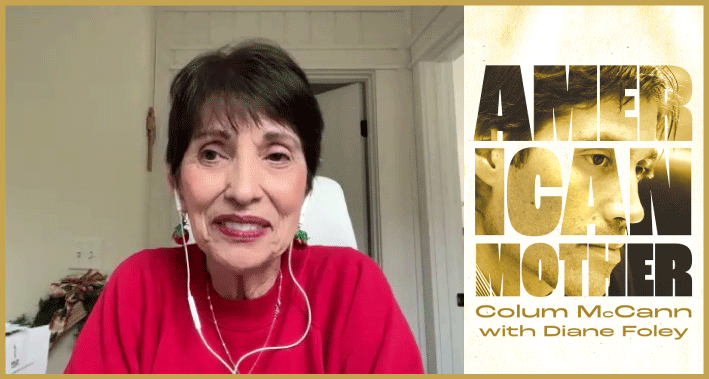
Devastated and heartbroken, Diane’s Catholic faith instilled her with the strength and guidance she needed to get through that experience, led her to work on behalf of other hostages, and even motivated her to show a measure of grace and mercy to one of her son’s killers. She shares her story in the book “American Mother,” co-authored with Colum McCann, and we discussed it recently on “Christopher Closeup” (podcasts below).
Though “American Mother” was written as a result of James’ death, what it really captures is the way he lived because Diane believes that is his true legacy. From his earliest years, Jim (as Diane calls him) was a good-hearted, easygoing, happy child who went out of his way to help others. For instance, when a fellow student had no place to live, Jim invited him to stay with their family for the summer.
“One of the turning points for Jim,” Diane recalled, “was when he went for his undergraduate work to Marquette University in Milwaukee because their ethos is: be the difference…The university challenged him from freshman year to volunteer in the inner city, which surrounded Marquette University at that time. Jim embraced that. I think it opened his eyes to the fact that there’s a lot of poverty, there’s people who don’t have a mom or a dad or breakfast. So he did volunteer work throughout his years at Marquette, which included Habitat for Humanity, working on American Indian Reservations, etc. I think all of this was preparing his heart…to have more compassion and to realize there were people in the world who needed care.”
Marquette’s Jesuit ethics of “being a person for others” continued guiding Jim’s life choices. He worked at Teach for America and continued mentoring students after his time with the organization was completed; he volunteered at a care center for unwed mothers; and he worked at Chicago’s Cook County Jail, helping inmates earn their high school diplomas.
In addition to the Jesuit influence, Diane also noticed a Franciscan bent in Jim, observing that he “was very happy with nothing. He just wasn’t about accumulating things. He accumulated deep friendships, and he had friends all over the world…He really didn’t need anything but others and wanted to be a friend to others.”
Jim developed a passion for storytelling. He chose to become a journalist to help readers know and care about people in need and, eventually, people in conflict zones around the world. Diane believes his international focus stems from Jim having “three younger siblings who were in the Army, Air Force and Navy, and two of them were in Afghanistan and Iraq at the time.”
Though Diane worried constantly about her sons in Iraq and Afghanistan, she admits she was “clueless about the risks that journalists take…the risks that freelancers [take], particularly in conflict zones, but even domestically when they’re doing real investigative journalism…It takes moral courage to want to dig into the truth and get those voices heard, and I didn’t realize how dangerous it could be.”
That became evident in 2011 when Jim and several other freelancers working in Libya were taken hostage by Qadaffi loyalists. Unlike some journalists for major outlets, freelancers do not have security teams to back them up, so the danger they face is higher than average. Diane was shocked when she received the news about Jim’s abduction. His brother Michael took a leave of absence from work to engage with the U.S. government and try to get help to secure Jim’s release.
Meanwhile, Diane and her husband John relied on their faith for strength. She recalled, “I remember John and I going to the adoration chapel and praying…It was like the Lord had been preparing me for this in so many ways. I became a Catholic not until I was 16, because my dad was Unitarian, my mom was Roman Catholic, and they disagreed what faith I should be baptized in. My dad said, how about [we] wait until she’s of age and let her decide? From then on, spirituality has been very important to me, and I’ve been gifted with a gift of faith and a lot of good people who’ve nurtured me along the way….I remember as a preteen, my dad had an office in our little town in New Hampshire, and I would go down to St. Bernard’s Catholic Church. In those days, they were all open. I remember being drawn to the Blessed Mother, to the stillness and the sacred space…No matter where in the world I’ve been, I’ve been able to find a Mass to go to and the Blessed Sacrament to sit before. What a gift! It’s a treasure that I think often we Catholics forget about or take for granted perhaps.”
Other people also served as God’s messengers in Diane’s life. David Bradley, the head of Atlantic Media, whose freelancer Clare Gillis was taken hostage with Jim, offered the Foleys whatever assistance he could, while Diane’s parish prayed for Jim’s safety constantly as well. Diane observed, “One of the most difficult things is to be in despair and be alone. And I was not alone. That’s partly because I knew God was with me, but I also had the grace to see God in so many good people around me.”
When Jim was released after six weeks, he said that he could feel people’s prayers lifting him up during his captivity. He also revealed that a fellow prisoner had passed some Scripture verses to him through a hole in the cell, allowing him to meditate on them. Though the entire experience could have prompted Jim to pursue a safer career, he instead found himself even more deeply committed to practicing “moral courage.”
Diane explained, “In journalism, that meant to dare to hunt for the truth, dare to tell the truth, dare to investigate it and bring it to light. But [Jim] also knew that sometimes doing that would get you arrested, as it did in Libya, or condemned by colleagues who might not want the full story to come out. I think by then Jim was more aware that it’s not always easy to do the right thing, to tell the truth, to bear witness to the truth, that often there’s a lot that can suppress that.”
After spending some time back in the U.S., Jim returned to the Middle East. It was becoming increasingly dangerous there due to the Arab Spring, so journalists with major companies were leaving. Freelancers filled the void, so Jim took part in that. He worked there for about a year before being taken hostage by ISIS in Syria on Thanksgiving Day 2012.
Diane retired early from her job as a nurse practitioner to work with the U.S. government to secure Jim’s release. However, there was no dedicated person or office to handle hostage situations. Diane felt that the government largely gave her the runaround and even lied to her about how important that saving Jim was to them. Part of the problem was the policy we’ve likely heard on TV or in movies: we don’t negotiate with terrorists.Diane explained, “When you don’t negotiate in some ways with bad guys, if you will – terrorists or nation-states that take our people – those people die. That’s what the research shows, that a country needs to find a way to engage or the people are in fact abandoned. So that’s what happened [with Jim].”
In August 2014, a video of Jim’s beheading was widely shared on social media and became international news. Naturally, Diane felt grief-stricken at her loss, but she prayed for the grace to move forward. She said, “I felt the Lord wanted me to somehow use the horror of all this for the good of others because I know that’s what Jim would’ve wanted. I know the Lord wants us to somehow find the light in the darkness…But it was a challenge and it required a lot of faith, a lot of the goodness of others. When bad things happen, we need one another….We need God with skin on, if you will. We need people who really care. And that’s been my experience. We received buckets of mail for a full year after Jim was murdered, and it was through a lot of that goodness and some of those donations, we were able to start the Foley Foundation.”
The James Foley Legacy Foundation was founded within three weeks of Jim’s death to continue his work of “moral courage.” In addition to advocating for the safety of journalists in conflict zones, the Foundation’s work also resulted in finally establishing a single government point person to handle hostage situations: the Special Presidential Envoy for Hostage Affairs. To date, the Foundation has helped bring home more than 140 innocent U.S. nationals.
Years later, two of Jim’s murderers were captured and extradited to the U.S., and one of them – Alexanda Kotey – plead guilty to all charges and offered to meet with victims. It was not an easy decision for Diane, but she felt it was something Jim would have done himself to hear the man’s story. Since no member of her family wanted to interact with Kotey, Diane’s co-author, Colum McCann, came along as her family friend and documented what occurred. Diane credits God with giving her the peace to get through this unusual exchange.
“One of Jim’s gifts was as a listener,” Diane said, “and I wanted to be able to see Alexanda Kotey. I wanted to be able to hear him as Jim would’ve heard him. I wanted to hear his rationalizations, his story. But I also, as a mom, wanted him to know who Jim was because I knew that a lot of the jihadists objectified the prisoners and just saw them as images of anything bad our country’s ever done, and not as people. But thanks be to God, I was able to hear him, and I really felt he heard me. He ended up writing me three letters after our encounter…He won’t probably ever see his family or his home country again, which is important. That accountability needs to happen when people commit horrific crimes. But by the same token, there was a humanity.”
Would Diane say she has forgiven Kotey? “It’s grace, it’s mercy. He never really asked me to forgive him. He did express remorse. I think forgiveness is a lot of times an interaction, but certainly I’m willing to forgive…Hatred is sad. When we choose to hate one another, everybody’s hurt. Everybody. And when we dare with God’s grace to try to love, there’s hope for everyone.”
In co-writing “American Mother,” Diane hopes that Jim’s story offers future generations hope and courage in pursuing truth. The book is also a testament to the strength and guidance we can all draw from faith. She said, “I think the challenge is for all of us to use whatever happens in our life, gifts or tragedy, to try to find God in it because then God meets us and gives us the strength to do what we can, to do what He intends with whatever is there. So, God is my strength. There’s no question. I wouldn’t be standing today without my faith in God.”
(To listen to the full interview with Diane Foley, click on the podcast links):
 Light One Candle - the blog of The Christophers