 Posted by
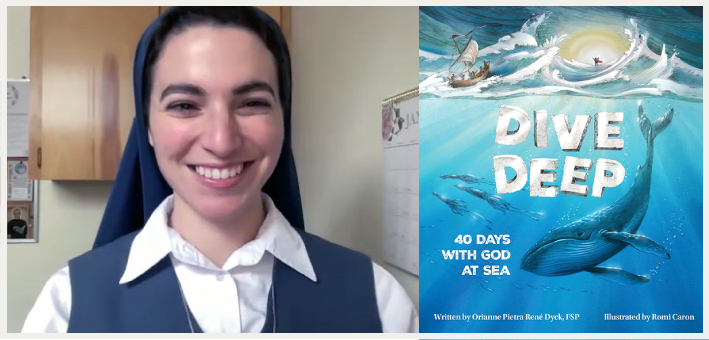
 What does Pharaoh, in the story of Moses and the Exodus, have in common with a porcupine fish? Did the apostles ever say things to Jesus that made Him facepalm? These may not be questions you’ve ever thought of, but Daughter of St. Paul Sister Orianne Pietra René Dyck sure has, and the answers she found make these Scriptural stories come alive for children (and adults) in new and exciting ways.
Sister Orianne shares her insights and research in the book “Dive Deep: 40 Days with God at Sea,” written for kids ages nine to 12, and illustrated by Romi Caron.
Sister Orianne converted to Catholicism at age 12, after having been raised in a half-Protestant, half-Druze family. During a “Christopher Closeup” interview (podcast below), she reflected, “I think the beauty that comes – along with the confusion – of being raised between two different faiths is that you have to ask questions. I fell in love with the Lord at a very young age through Scripture, but I was reading Scripture and the Koran at home. That kickstarted a lot of questions in me…The more I asked questions – and asked them of God Himself because I knew that He was the one who had all the answers…- that He really started to bring me back to that question of who loves and who is love beyond the human conception of what love could be. That brought me back to the cross. I found in the Catholic Church this beautiful ability to hold who Jesus was, as our most personal, intimate friend – and also as God, who created the universe.”
As a former teacher, Sister Orianne found inspiration for “Dive Deep” when thinking about her former students and the struggles they faced. She realized she dealt with some of those same spiritual struggles herself and believes there is a universality to them. She felt God invite her to break open Scripture for youth “in a living way,” which is what He did for her at their age. As the daughter and granddaughter of scientists, she used elements from both faith and the natural world to convey her insights.
One of them has to do with the aforementioned Pharaoh and the porcupine fish. When reading about the Exodus, Sister Orianne initially felt troubled by the statement, “The Lord hardened the heart of Pharaoh” because it sounds as if God is infringing on his free will, which would raise all kinds of theological problems.
Upon further investigation, Sister Orianne learned the opposite was true. She writes, “In Scripture, when God says that He will harden the heart of someone, He isn’t saying He is going to make that person unable to listen to Him. He is saying that is the reaction the person is going to have to His words. In fact, before this story in Exodus 8, it explicitly says that Pharaoh hardened his own heart, showing us that Pharaoh was choosing not to listen to God’s words. And God, respecting Pharaoh’s free will, let him choose this.”
So how does this relate to porcupine fish? Pharaoh reacts like one because he feels threatened. “[Porcupine fish are] quite small and unmenacing in a usual day,” she explained, “but they swallow a bunch of water when they feel threatened. It puffs them up, and it makes their spikes stick out so you literally cannot touch them. I thought that was such a profound, physical, visible example of what we often do to ourselves, to our own hearts, when we feel like someone is infringing on our ability to control what is around us. We get defensive, we swallow a bunch of water and we’re like, ‘I don’t care why you’re here. I feel threatened. Go away.’ So often, we do that to people who love us, who are trying to help us. But we also do it to God, who’s trying to heal us and set us free…To be able to see that reflected in a physical example can make us realize, ‘That’s exactly what I’m doing, and maybe I don’t want to do that to God.'”
Staying with the Exodus story, Sister Orianne also dispelled a myth grounded more in the visual imagination of Cecil B. DeMille rather than actual Scripture: namely, that the parting of the Red Sea happened instantaneously upon Moses raising his outstretched hands.
“I watched ‘Prince of Egypt’ growing up,” Sister Orianne explained, “so it’s an immediate parting, which is a beautiful way to depict it on film because it says something towards the truth. But in the Scriptures, it talks about this wind blowing throughout the night and that was what parted the waters…To be able to explore the spiritual lessons that this story has for us, even today, we have to be able to go back to what actually happened. To be able to wait on a miracle when things are going crazy all around you is so important. And to recognize that’s what the Israelites had to do as they were waiting to flee. They were still fleeing from Egypt. The Egyptians were right behind them. There was a pillar of fire dividing them, no idea when this pillar was going to stop – and they were waiting for the sea to part so that they could flee. We have to be able to wait on the Lord’s timing, and it’s perfect to be able to see it having happened throughout history.”
Sister Orianne has become skilled at seeing the presence of God all around her, but she realizes that not everyone’s eyes are open in the same way. On an Instagram post, she once lamented, “We miss the masterpieces of the mundane that have God’s fingerprints all over them.”
These realities are physical, emotional, and spiritual. She observed, “When we feel the impetus of a sisterly or brotherly or motherly or fatherly heart towards someone else, God is giving us a little glimpse into His heart. And likewise, when we see the beauty and wonder in creation, when we see how certain things interact with one another or how they’re just too perfect to be a coincidence in order to interact with one another, these can reveal to us things about God.”
There is also no reason for science and faith to be seen as opposing forces, as some people do today. “I think it’s a misnomer to pit science and faith against each other,” Sister Orianne said, “because science is the exploration of the rules, so to speak, of physical reality that the Lord has made. And faith is the exploration of the heart of this God who made those physical things and our relationship with Him as people made in His image and likeness…To be able to hold the Lord as the Creator means that we don’t need to be threatened by people exploring creation. We are welcome to do it and encouraged to do it. So many amazing, brilliant scientists were faithful Catholics, some even saints, for that very reason.”
Sister Orianne infuses “Dive Deep” with touches of her own personality, which comes across as both humorous and joyful. While studying God and Scripture can be seen as serious business, there can be a lighter element to it as well. For instance, Sister Orianne shares the story of Jesus condemning “the yeast of the Pharisees.” The apostles, oblivious to His point, think he’s complaining about them not having enough bread. Sister Orianne then imagines this could be a moment when Jesus does a facepalm.
“I think it’s important to recognize that if we are made in the image and likeness of God and we have humor, so does God,” she noted. “And we actually see throughout Scripture that He has little quips and little jokes. He is a God of joy. We see the Lord rejoicing in the New Testament. To be able to recognize that He is the God who will sit in the dust with us at our lowest moments – and who will laugh and rejoice with us in our moments of joy, I think [that] hits home.”
(To listen to my full interview with Sister Orianne, click on the podcast link):
 Light One Candle - the blog of The Christophers