 Posted by
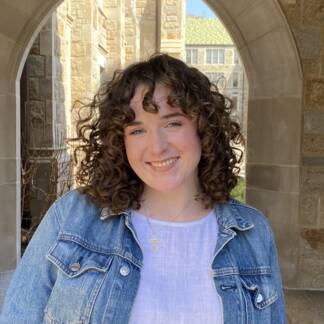
 When writer Delaney Coyne set out to explore the Catholic Church’s ministries to people with intellectual and developmental disabilities, she approached the topic with some firsthand knowledge. Her younger sister, Charlotte, has an intellectual disability.
As they were growing up together, Delaney witnessed the challenges and victories that Charlotte experienced when it came to learning and practicing her faith. That made Deleaney wonder how the Church was currently meeting the needs of this sometimes-overlooked community. She joined me recently on “Christopher Closeup” (podcast below) to share what she learned.
Charlotte is now 21, Delaney said, and is “in a transition program through the public school in the state of Illinois…She loves going to church. She loves finding community with her peers. She’s super social. At our parish, there’s a special friends Mass that she loves attending. She’s also involved in the community of Misericordia, which is a home for people with disabilities in Illinois. She’s not a resident, but she…goes to their events and makes friends there, and it’s really lovely.”
There were some bumps along the way, however. Charlotte and other students with intellectual and developmental disabilities took different catechesis classes than neurotypical kids like Delaney because they wouldn’t have benefited from a traditional classroom setting. Though that experience was positive, others were not.
For instance, on the day of her Confirmation, Charlotte felt a great deal of anxiety, so she ran out of the church because she did not want to receive the sacrament. Her family followed her, as did the bishop, who forcibly anointed her with oil in the hallway while she screamed, “No, I don’t want!”
Delaney recalls, “I’ve come to a kind of compassion for the bishop. I still think what he did was wrong. It is not in line with the guidelines for the celebration of the sacraments with people with disabilities, but I don’t think he totally knew what to do in that moment because this has not always been the top priority of our Church. We haven’t always put people with disabilities at the center…It was also formative for my own faith in that it presented a real challenge to it. For a while after that, I saw the Church as this very rigid institution, forcing initiation and membership at all costs, even if it went against the needs and wishes of the people, which I saw as uncompassionate. It colored my view of the Church for quite a while.”
Charlotte, however, provided the theology lesson Delaney needed to find her connection to God again: “Charlotte reminds me that there’s something a lot deeper to faith than just knowledge. My background is in academic theology…so much of my life and my engagement with my faith is knowledge based…I love it. It’s beautiful, but that’s not what faith is, in and of itself. You have this in Joseph Ratzinger’s ‘Intro to Christianity.’…[Faith is] an encounter with the man, Jesus, and in this encounter, it experiences the meaning of the world as a person. If it’s strengthened by intellectual pursuit, that’s wonderful. Knowledge can be liberating. It has been in my own experience, but it’s not the only way. This very cognitive model of faith has been limiting for our brothers and sisters with intellectual disabilities.”
“My sister does not want to receive the Eucharist,” Delaney continued. “She engages with the faith in a different way than I do. She’s often a much better Christian than I am. She sees the good in everyone. She shows love to everyone, and she’s open to love. It reminds me to break from my own rigidity and see the mystery of God’s abundant love. So, my image of faith and image of the Church was bound up in my relationship with my sister. I came to know God through going to church with my family and sitting next to her, and I learned who God is and what love is. It reminded me that there’s this real power of unity in diversity. There’s no one way to be a Catholic Christian.”
One of the places that gets disability ministry right is St. Therese of Lisieux Church in Cresskill, New Jersey. Its pastor, Father Samuel Citero, O.Carm., was inspired by a trip he took to Lourdes in 2015. He witnessed the work of the American Special Children’s Pilgrimage Group, which offers trips to Lourdes for people with disabilities, providing them with specialized care so they can travel without their families. After seeing the community and fellowship that people with disabilities experienced there, he suggested starting Masses in a similar style at St. Therese. Parishioners loved the idea and quickly got things going.
As a result, St. Therese celebrates a monthly special needs Mass that welcomes both those with disabilities, as well as the wider parish community. People with disabilities serve in all parts of the Mass, from altar servers to lectors to the choir.
When she attended one of these special needs Masses, Delaney found herself deeply touched by its life-affirming and faith-affirming spirit. She said, “People with disabilities are often marginalized and isolated, and their families struggle to find resources because they’re also isolated. This is a way of bringing people together. It’s also led to growth in their parish. They have seen membership rise from people that are joining because of this ministry. It’s focused on personal relationships. They meet in the parish hall after the fact, and it cultivates this relationship between the pastor and community.”
For the article she wrote about disability ministry for “America” magazine, Delaney spoke with Lori Weider, chair of the National Catholic Partnership on Disabilities Committee on Intellectual and Developmental Disabilities (NCPD). She learned that there has been “significant growth” in ministries for people with disabilities in the last 20 years. The U.S. bishops are also making this a priority.
“The flip side,” Delaney explained, “is that it also needs to trickle down to the local level. So much of this work depends on individual relationships because all people with disabilities are different. What is true for someone who might have mobility issues and be in a wheelchair, is not true for someone who might have severe sensory issues, which is not true for someone who might have severe cognitive impairments. So, it’s necessarily local. It has to happen at the parish level.”
When a diocese has a specific office and point person focused on disability ministry, everything becomes easier to navigate.
Another advance is an increase in “sensory-friendly Masses…This makes Mass accessible to those who might not otherwise be able to access it. Think of someone with a sensory issue. A really loud organ and a ton of incense that might be beautiful for another person might end up being genuinely prohibitive…for this person.”
Pope Francis’s 2020 statement that we shouldn’t deny people with disabilities the sacraments has also been a positive factor. “It seems almost absurd that this would need to be an update made in 2020,” Delaney said, “but I spoke to multiple families who did experience that with their children. People who wanted to receive the Eucharist, the pastor said, ‘No, they don’t understand enough’ or ‘We can’t prove that they understand.’ Not all will want to receive, but many do. A lot of this is a shortcoming [because people with intellectual and developmental disabilities] say that they don’t understand. But without catechesis that can help them understand, it is essentially leaving a major portion of the Church high and dry and without access to that grace that they deserve by virtue of their baptism.”
While there is some willingness to catechize people with disabilities, teachers express fear that they won’t know how to do it. “The problem is when we let this fear have the last word,” Delaney noted. “We need to trust ourselves to learn how to minister to each and every member of the body of Christ, trusting people with disabilities to make decisions about their own spiritual lives and participate in the Church that they belong to, and also trusting the power of the spirit. Even if faith might look differently to them than it does to a neurotypical eighth grader…they have faith just the same.”
Ultimately, people with disabilities need to be seen by all their fellow Catholics as “members of the body of Christ,” Delaney concluded. “They’re not doing something different or something lesser or Catholic lite. They are brothers and sisters. They belong just as much as we do as neurotypical Catholics…Disability ministry is not something that is done specifically for people with disabilities. It’s done for the life of the Church as a whole. It doesn’t mean we shouldn’t center people with disabilities in that ministry, but it’s incumbent on all of us.”
(To listen to my full interview with Delaney Coyne, click on the podcast link):
 Light One Candle - the blog of The Christophers