
 Posted by
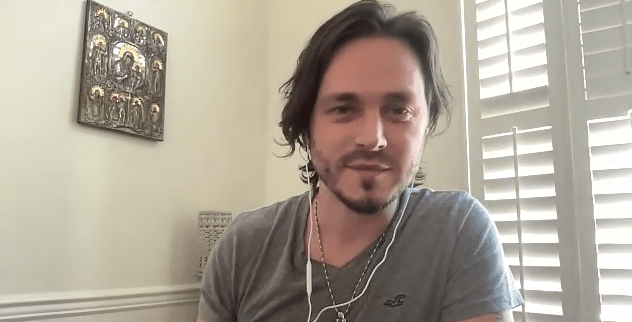
 The term “child star” sometimes brings to mind stories of kids whose lives went off the rails after achieving celebrity at a young age. Jonathan Jackson, however, never fell prey to those temptations, thanks to the supportive family members and co-workers who surrounded and grounded him after he was cast on ABC’s “General Hospital” at age 11 in 1993. In addition, Jonathan felt called from an early age to pursue a relationship with God, so he kept his ever-growing Christian faith as the foundation of his choices and actions.
In the years since then, Jonathan has evolved as both an artist and a Christian. Professionally, he founded the band Enation and starred as Avery Barkley in the TV series “Nashville,” which combined his passion for both acting and music. Spiritually, he moved through various Protestant beliefs, but ultimately found a home in Eastern Orthodox Christianity a little more than 10 years ago. Inspired by his faith, he published an epic, mystical poem titled “The Harrowing of Hell,” an imaginative look at what transpired in the three days between Jesus’s death and resurrection.
Jonathan also returned to “General Hospital” recently, so he joined me on “Christopher Closeup” (podcasts below) to discuss all these aspects of his life, career, and faith.
When Jonathan joined the cast of “General Hospital” at age 11 as Lucky Spencer, he was inducted into soap opera’s most famous family, portraying the son of the iconic Luke and Laura Spencer (Tony Geary and Genie Francis), whose TV wedding in 1981 captivated the world. And for those who don’t remember that era or weren’t born yet, that’s not an exaggeration.
“I was so blessed because my parents in real life are really beautiful people that I’ve learned so much from,” Jonathan explained. “And then in the artistic world, I was given Tony Geary and Genie Francis as these incredible parental figures and mentors. I feel like I could almost write a book about how much they gave to me, both in words and instruction, but also example.”
Geary and Francis had endured the pinnacle of fame and absorbed the positive and negative lessons it brought. That guided how they interacted with their TV son.
Jonathan recalled, “I was seeing very successful people, many of them with a high degree of fame, and I was seeing a lot of different versions of that…Anthony Geary, for instance…was always one of the most humble people that I ever worked with. And he had an incredible amount of fame…I was working with him at a time in his life where he had such humility and graciousness. That really spoke a lot to me…It’s the same thing for Genie. She’s so giving, so loving. I feel like, I don’t know why, but they both set out to protect me.”
“Then,” Jonathan continued, “[there were] other people, other examples that I would see around me of success and wealth and power – and they were miserable. Their lives were in chaos. I was a kid at the time, so I’m observing all of this and going, ‘Wow, fame is horrible…and it’s corrosive to the soul.’ And in Hollywood, it’s weird because you either get this praise and adulation that is way over the top – it’s not good for anybody to receive that kind of praise; it’s just corrosive and disorienting – or you’re getting incredible criticism…[But] Genie, she always told me to trust my instincts, which is a very important thing. Performing is a rough business. It’s like you have to be vulnerable to perform, but it’s the most critical and judgmental and embarrassing process knowing that everyone’s watching you. So…at a young age, to have these people that are so good at what they do and seasoned and everything, to have them tell you, ‘Listen, block it all out, trust your instincts,’ that was a huge, huge blessing.”
Another blessing was the way that Jonathan was slowly exposed to different Christian beliefs that kept him grounded. “I’m very thankful that in the various Protestant circles that I grew up in,” he recalled, “I was sheltered from the most fundamentalist, puritanical, legalistic [views], which can often be a bit traumatizing for people…There was, I would say, a very orthodox balance of grace and truth. I wasn’t raised [with this belief that] sin doesn’t really matter, just accept everything. But it also wasn’t this hyper-legalistic, fundamentalist thing where you’re just judging everyone. I remember reading ‘Mere Christianity’ – I think I was maybe 14 or 15 at the time – and C.S. Lewis’s chapter on the Great Sin, which is…pride. That revolutionized my life because…I started to hear my thoughts for the first time, really. When I was talking with people, I didn’t know I had all of these judgments [of them]. I started to become aware of it, and then every time it would happen, I would repent, and I’d say [to God], ‘Take that from me.'”
“I remember a very important moment in prayer where I felt like the Holy Spirit, as I was praying about this, said, ‘I’m not showing you these things to condemn you. I’m showing you these things to set you free.’ So, I was able to receive the conviction without being condemned because Christ said, ‘I didn’t come to condemn the world, but to save the world.’…It was the preparation that continued into our journey into Orthodoxy because one of the main things that is focused on in Orthodox Christianity is, ‘I am the chief of sinners.’ And whoever you’re talking with, no matter where they come from or what background they are, the disposition of the soul should be an imitation of Christ, one of humility to say, ‘You will most likely enter the kingdom of heaven before me, so please pray for me and put a good word in for me. And I want my disposition to be that when you reach the [pearly] gates before I do, that, if Christ says, ‘What was your experience with that person?’ you might say, ‘He never judged me.'”
It was Jonathan’s immersion in Orthodox Christianity that led him to write the epic poem “The Harrowing of Hell, ” about Jesus’ descent into Hades, following His crucifixion, to set imprisoned souls free. In addition, Jonathan also recorded the audio book and composed a score as a “companion contemplative” piece.
“One of the things that I discovered journeying into the Orthodox Church,” Jonathan explained, “was a theological…vision or perspective around hell that I had never heard before. And it moved me very, very deeply…I believe it was Father Thomas Hopko that I heard this from originally, but he talked about how even the flames of hell are God’s love. It’s not that God [is] like a pagan deity full of wrath and punishment. It’s that God is always love. His face is always turned towards us in love, oftentimes with tears imploring us. As Christ said, the Father is not willing that any should perish. That’s the desire of God’s heart. And yet we have free will. So, the experience in hell, the descriptions of burning and flames and all of these things, it’s not a vengeful, petty, angry God. It’s the experience of a soul that has rejected perfect love. And the flame of God’s love experienced by a soul that has rejected goodness and beauty and mercy and all of those things, then that love feels like it’s burning you…I think a lot of the intent for me was wanting to explore the mercy of God and free will in that context.”
Free will becomes a major part of “The Harrowing of Hell” early on when Jesus goes to Absalom, who is chained to hell because he sinned against God and his father, King David. Jesus invites Absalom to repent of his sins, let go of his shame, and join Him in heaven. Absalom is unsure at first, so Jesus explains that the decision is his alone. “Don’t you understand?” Jesus tells Absalom. “I am helpless before your freedom.”
Jonathan also set out to explore the humility of Jesus in this poem, noting, “In the Orthodox Church, there’s a title for Christ. He’s called the Great Humility, which has always really struck me. And there’s an icon that is called The Great Humility…where Christ’s head is tilted down from voluntarily accepting the sins of the world for us. There’s such beauty there…The humility of taking on our flesh…receiving beatings and mockery and spitting and false witness and all of these things, and never returning any of that except with love, grace, mercy, and truth. To be hanging on the cross and say in that moment – not philosophically or ideologically preaching forgiveness – but literally hanging from the cross saying, ‘Father, forgive them,’ that is just incredible.”
The mercy of God is another aspect of Christianity that Jonathan sought to examine, partially because of his own past, referenced earlier, when he discovered and repented of his own judgment of people. In “The Harrowing of Hell,” Jesus offers salvation to souls that human beings may not think are worthy of being offered salvation. As Jesus says in the story, “Mercy, Absalom, not sacrifice, is the way to heaven.”
“It’s impossible to impress God with our self-righteousness,” Jonathan reflected. “Just stop the madness, and come to Christ. Look at the thief on the cross. There was nothing he could do in that moment to earn anything, except [express] this beautiful repentance and say, ‘Lord, please remember me when You come into Your kingdom.’ Christ doesn’t turn to him and say, ‘Well, a little late here, buddy. You don’t have time to earn it. You’ve wasted your life.’ No, He turns to him and He sees the honesty of this repentance, this soul who is giving everything he has to Christ and recognizing who He is, and He says, ‘Today, you will be with Me in paradise.'”
Though it might seem a stretch to find a connection between Jonathan’s faith and his return to “General Hospital,” soap operas thrive on stories of sin and redemption, virtue and vice. And the truth is that the character of Lucky Spencer has his own share of sins that he needs to repent of, including leaving his family and child behind. Jonathan relishes the challenge of revisiting this character and the story potential inherent therein.
He concluded, “It’s an interesting experience. It’s very unique in this industry. I left the show in 1999…I was there for about six years. I left for a decade, and then came back when I was 28 and worked a lot with Tony, which was amazing. Now, I’ve been gone for 12 years, and I’m back working with Genie this time. What other medium would you be able to work with people [from] 11 years old to 17 or 18, and then a decade later, come back as a 28-year-old, and then again, [at] age] 40.?…It’s really wild, it’s very surreal, but it’s fun as well.”
 Light One Candle - the blog of The Christophers