
 Posted by
 A paranoid ruler, desperate to cling to power, feels so threatened by manipulative forces around him that he comes to suspect his children are trying to overthrow him, leading him to torture and execute them.
No, it’s not the plot of some new, hot TV show. It’s a piece of history about a man most people know little about: King Herod – the one who ordered the murder of all boys under age two after hearing from the Magi that the king of the Jews was born in Bethlehem.
The gospel of Matthew only gives a taste of the evils Herod committed. But now his story – as well as a contrasting one about a model of holiness – is being told by an unlikely source: Kathie Lee Gifford.
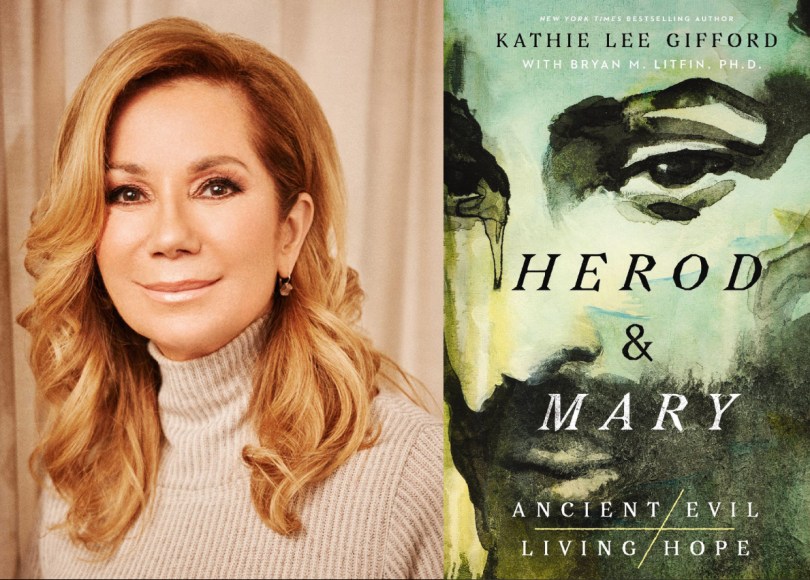
Known for her upbeat, positive personality on morning TV from her years working with Regis Philbin, and later Hoda Kotb, Kathie Lee has long been a student of Judeo-Christian history. She is sharing what she has learned in the new book “Herod and Mary: The True Story of the Tyrant King and the Mother of the Risen Savior,” co-authored with Dr. Bryan Litfin. It is the first in a series titled “Ancient Evil/Living Hope.” Kathie Lee joined me recently on “Christopher Closeup” (podcast below) to discuss the book.
Kathie Lee revealed that she has always been fascinated by biblical history, but a trip to Israel with her husband Frank a little more than 10 years ago changed her understanding of Scripture. She said, “Unless we study what the original languages of the Scriptures were and are – meaning Hebrew in the Old Testament, Greek in the New [Testament] – we are not hearing the word of God. We’ve been reading the King James version of the Bible and thinking that’s the only [one]…That’s where we all learned Jesus was a carpenter. Well, guess what? He was not a carpenter. There was no buildable wood in first century A.D. at all. Everything was stone…So when I started learning, truly, how to study the Hebrew, and what it actually means, and the Greek, it changed my life completely. It lit a fire in my very, very, very bored and lukewarm faith, and I’ve never been the same since.”
It was during that trip that Kathie Lee first heard about Herod’s background. She became so intrigued by him that she sought out books about his life and the politics of the era in which he lived, including his relationships with Mark Antony, Cleopatra, and Julius Caesar. And though Herod dubbed himself the “king of the Jews,” he was not actually a full-blooded Jewish man, but rather an Idumean. Herod tried to make up for this shortcoming through marriage, but that plan ultimately went awry.
“This is such a dense story of the evil of Herod,” Kathie Lee explained. “He murdered almost everybody in his family, his own children, the only woman he ever loved, Mariamne. He murdered anybody that was a true enemy or just he thought might be or could become [one]. So, he was a paranoid man, but incredibly gifted, probably the greatest architect that has ever lived on the face of Earth….He built that marina at Caesarea Maritime. This man was so genius, he found a way to pour concrete 150 feet into the Mediterranean Sea and build a marina for Caesar’s ships. That’s the way Pontius Pilate got there; on one of Caesar’s ships.”
Despite Herod’s many sins, in his own mind, he believed he was virtuous and favored by God. “Herod wanted to be his own god,” Kathie Lee said. “He knew there was a God out there that he kind of needed, and he’d give money to everything. Every time he’d honor a Roman god or a Hellenic, a Greek god, it would anger the Jews and the Zealots…It was just a melting pot of disaster and chaos waiting to happen. And he was right in the center of all of it…How really, truly relevant his story is even now. Rip it out of the headlines, people are doing this all over the world, still this kind of evil. So, it’s always been here, but God has always had a presence in the midst of it.”
God’s presence in “Herod and Mary” obviously comes from the second of those two names: Mary, the mother of Jesus. Kathie Lee included Mary as a contrast to the self-absorbed, power-hungry, violent way that Herod lived his life. She said, “I want to give people hope, and nobody represented hope more than a little Jewish virgin, growing up in a village of maybe a couple of hundred people called Nazareth. Born into poverty…certainly not born into what the world would say would be greatness. But she found favor with God. Why? Because of her pure heart, because of her spirit, because of her goodness.”
Whereas Herod was willing to lose his soul to gain the world, Mary’s example of humility reflected God’s own choice to humble Himself and become human. And Kathie Lee notes that Mary remains a role model for all of us: “I sometimes say to some of my friends, ‘You guys want to just be the coolest guy in the room. You know what God wants you to be? How about the kindest person in the room?’ That’s what He wants of me. That’s what He wants of you…I’ve never separated the secular from the spiritual. I am a child of God whether I walk into a brothel so I can talk to prostitutes, which I have done, or if I walk into a bar, and somebody’s throwing up, and I take them, and I clean up their vomit for them, and I tell them about Jesus. That’s what we’re supposed to do. The word church is ‘Ekklesia’ in Greek. It means a movement, not a building. We’re a movement of the Holy Spirit.”
Kathie Lee emphasizes that this movement originated with the Jewish people. She feels profound sadness that this truth makes some people uncomfortable and has often led to – and still leads to – antisemitism. “Jesus’ first followers were all Jews,” she said. “His whole family was [Jewish]…Jesus was a rabbi…He was a Jew. And people recoil sometimes that this is the story. Well, you either believe it or you don’t, and that’s your right. But you disbelieve it or you’re cynical about it at your loss. It’s such a rich history….Jesus said, we’re supposed to love, this is our family…’Bet’ab.’ Bet’ab is Hebrew for the father’s house.”
Kathie Lee hopes that people who read “Herod and Mary” find it enlightening from a historical perspective, but that it also offers them light on the best way to live their lives. Citing the line from Micah 6:8 – “What does the Lord require of you but to do justice, to love kindness, and to walk humbly with your God?” – Kathie Lee concludes, “God himself became one of us so He could walk humbly with us. We’re all sinners saved by grace.”
(To listen to my full interview with Kathie Lee Gifford, click on the podcast link):
 Light One Candle - the blog of The Christophers