
 Posted by
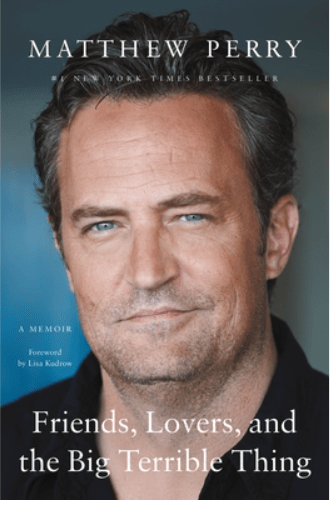
 I woke up this morning, surprised by the news of Matthew Perry’s death. When his memoir “Friends, Lovers, and the Big Terrible Thing” came out in 2022, I was intrigued to read about the addiction – and roots thereof – that had afflicted the brilliant comic actor’s life for decades. Still, I was shocked at the massive – and I mean MASSIVE – amounts of drugs that Perry had ingested over the years – many incidents of which almost led to his death, such as the time his “colon exploded.” Yes, you read that right.
It was a veritable miracle that Perry was still alive at age 53. And while he seemed to be in a good place during his book tour – having even come to a new connection with God – I also got the impression that his recovery was precarious, as it is with so many addicts.
And now, the man that made so many of us laugh as Chandler Bing on “Friends” has died of drowning at age 54. Whether his old addictions played a part remains to be determined, but Perry did reveal in his book that he struggled with sleep issues during much of his life and often turned to drugs like Xanax for relief..
Non-celebrities looking at a story like Perry’s might be inclined to think, “He’s on top of the world. What does he need drugs to feel good for?” Yet in Perry’s mind – even at the height of his success – he struggled with the belief that he wasn’t good enough, that if anyone got to know the real him, they wouldn’t like him. Perry also noted that he struggled with “a lifelong feeling of abandonment,” partially brought on by his parents not always having enough time for him – and by his father actually abandoning his family. Without his dad around, Perry took it upon himself to be a soothing, entertaining presence for his mother, trying to make her laugh and becoming a “people pleaser” in general. He went on to have decent relationships with both his parents, but that scared, fearful little boy inside him never seemed to disappear.
There were other potential seeds of addiction planted as well early in Perry’s life. Because he was a colicky baby who cried constantly and couldn’t sleep, the doctor – as many doctors did in 1969, Perry noted – prescribed the addictive barbiturate phenobarbital. He was given that drug from between 30 days to 60 days old, and it helped him conk right out. Perry wondered if that played a role in his future sleep problems and addictions.
Perry had his first drink at the age of 14, beers with his friends. The alcohol, he wrote, had a surprising effect on him: “For the first time in my life, nothing bothered me. The world made sense..I was complete, at peace. I had never been happier than in that moment.”
Perry kept trying to fill the emptiness inside with sex and alcohol, but that solution never worked. He wrote, “Whatever holes you’re filling seem to keep opening back up…Maybe it’s because I was always trying to fill a spiritual hole with a material thing.”
Perry believed fame would be the answer to his problems, so one day, for the first time in his life, he got on his knees and prayed, “God, you can do whatever you want to me. Just please make me famous.”
Three weeks later, Perry was cast as Chandler Bing on “Friends.” He reflected, “Now, all these years later, I’m certain that I got famous so I would not waste my entire life trying to get famous. You have to get famous to know that it’s not the answer. And nobody who is not famous will ever truly believe that.”
Though Perry was already an addict, the incident that would plunge him much further down that dark hole occurred while he was shooting the movie “Fools Rush In,” with Salma Hayek. After suffering a jet ski injury to his neck that left him in a lot of pain, a doctor prescribed a painkiller for him so he could get through his scenes.
Perry described that pill as leaving him “in complete and pure euphoria…I was close to God that morning. I had felt heaven – not many people get that. I shook hands with God that morning. Was it God, or someone else?”
In light of what followed, it was likely someone else.
Perry wanted to recreate that feeling, so he asked the doctor to send him more pills. The doctor had 40 more delivered to his house. Less than two years later, Perry was taking 55 of those pills a day. He speculated in his book about how the next three decades of his life might have been different if he simply hadn’t taken that first pill.
Perry went on to struggle with addiction for decades, and he went through many treatment centers and recoveries. But one in particular moved him toward a stronger spiritual life – at least for some time.
While detoxing from Xanax, Perry felt both physically and emotionally awful, filled with “shame and guilt.”
He wrote, “I frantically began to pray…’God, please help me…Show me that you are here. God, please help me.'”
Perry then noticed a “small, golden light” in the air growing bigger and bigger. “I was starting to feel better,” he recalled. “And why was I not terrified? The light engendered a feeling more perfect than the most perfect quantity of drugs I had ever taken. Feeling euphoric now, I did get scared and tried to shake it off. But there was no shaking this off. It was way, way bigger than me. My only choice was to surrender to it…For the first time in my life, I was in the presence of love and acceptance and filled with an overwhelming feeling that everything was going to be OK. I knew now that my prayer had been answered. I was in the presence of God. Bill Wilson, who created AA, was saved by a lightning-bolt-through-the-window experience where he felt he was meeting God. This was mine.”
“I stayed sober for two years based solely on that moment,” Perry continued. “God had shown me a sliver of what life could be. He had saved me that day, and for all days, no matter what. He had turned me into a seeker, not only of sobriety, and truth, but also of him. He had opened a window, and closed it, as if to say, ‘Now go earn this.’ Nowadays, when a particular darkness hits me, I find myself wondering if [that experience] was just Xanax insanity…But quickly I return to the truth of the golden light. When I am sober, I can still see it, remember what it did for me. Some might write it off as a near-death experience, but I was there, and it was God. And when I am connected, God shows me that it was real, little hints like when the sunlight hits the ocean and turns it into this golden color…And I feel it when I help someone get sober, the way it hits my heart when they say thank you. Because they don’t know yet that I should really be thanking them.”
Addicts never say they’re cured, but rather that they’re in recovery because they know that falling off the wagon is always a possibility. And so it was for Perry, who went on to suffer more personal and professional ups and downs. That doesn’t diminish the epiphanies he experienced, though, nor the people he helped make their own way through recovery.
His story of addiction is both a cautionary tale and, despite his sad ending, a story of hope because he fought the good fight and gained the wisdom he needed. Hopefully, Matthew Perry will now experience the unconditional love and acceptance he craved all his earthly life.
Eternal rest grant unto Matthew Perry, O Lord, and let perpetual light shine upon him. May his soul, and all the souls of the faithful departed, rest in peace. Amen.
 Light One Candle - the blog of The Christophers
One comment
Comments are closed.